


Page 32 - Read Online
P. 32
Page 6 of 9                                                   Tsai et al. Vessel Plus 2021;5:9  I  http://dx.doi.org/10.20517/2574-1209.2020.73


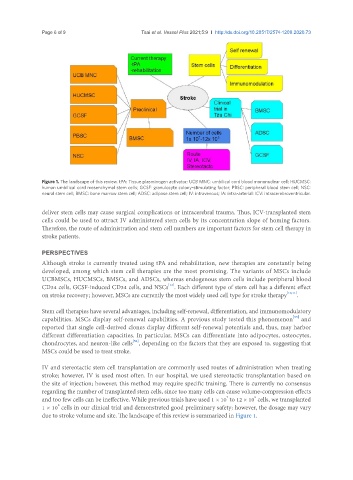
               Figure 1. The landscape of this review. tPA: Tissue plasminogen activator; UCB MNC: umbilical cord blood mononuclear cell; HUCMSC:
               human umbilical cord mesenchymal stem cells; GCSF: granulocyte colony-stimulating factor; PBSC: peripheral blood stem cell; NSC:
               neural stem cell; BMSC: bone marrow stem cell; ADSC: adipose stem cell; IV: intravenous; IA: intra-arterial: ICV: intracerebroventricular.


               deliver stem cells may cause surgical complications or intracerebral trauma. Thus, ICV-transplanted stem
               cells could be used to attract IV administered stem cells by its concentration slope of homing factors.
               Therefore, the route of administration and stem cell numbers are important factors for stem cell therapy in
               stroke patients.

               PERSPECTIVES
               Although stroke is currently treated using tPA and rehabilitation, new therapies are constantly being
               developed, among which stem cell therapies are the most promising. The variants of MSCs include
               UCBMSCs, HUCMSCs, BMSCs, and ADSCs, whereas endogenous stem cells include peripheral blood
                                                          [12]
               CD34 cells, GCSF-induced CD34 cells, and NSCs . Each different type of stem cell has a different effect
               on stroke recovery; however, MSCs are currently the most widely used cell type for stroke therapy [10,11] .

               Stem cell therapies have several advantages, including self-renewal, differentiation, and immunomodulatory
                                                                                                    [55]
               capabilities. MSCs display self-renewal capabilities. A previous study tested this phenomenon  and
               reported that single cell-derived clones display different self-renewal potentials and, thus, may harbor
               different differentiation capacities. In particular, MSCs can differentiate into adipocytes, osteocytes,
                                              [56]
               chondrocytes, and neuron-like cells , depending on the factors that they are exposed to, suggesting that
               MSCs could be used to treat stroke.

               IV and stereotactic stem cell transplantation are commonly used routes of administration when treating
               stroke; however, IV is used most often. In our hospital, we used stereotactic transplantation based on
               the site of injection; however, this method may require specific training. There is currently no consensus
               regarding the number of transplanted stem cells, since too many cells can cause volume-compression effects
                                                                             7
                                                                                       8
               and too few cells can be ineffective. While previous trials have used 1 × 10  to 12 × 10  cells, we transplanted
                    8
               1 × 10  cells in our clinical trial and demonstrated good preliminary safety; however, the dosage may vary
               due to stroke volume and site. The landscape of this review is summarized in Figure 1.

