


Page 65 - Read Online
P. 65
Barioli et al. Vessel Plus 2024;8:13  https://dx.doi.org/10.20517/2574-1209.2023.68   Page 3 of 14


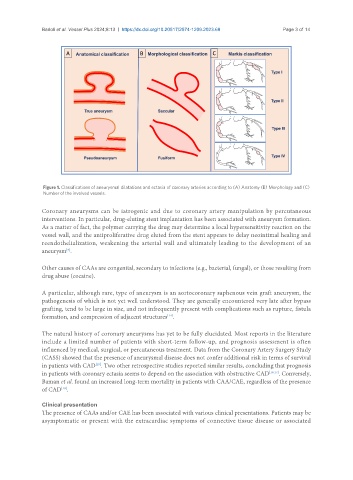
                Figure 1. Classifications of aneurysmal dilatations and ectasia of coronary arteries according to (A) Anatomy (B) Morphology and (C)
                Number of the involved vessels.


               Coronary aneurysms can be iatrogenic and due to coronary artery manipulation by percutaneous
               interventions. In particular, drug-eluting stent implantation has been associated with aneurysm formation.
               As a matter of fact, the polymer carrying the drug may determine a local hypersensitivity reaction on the
               vessel wall, and the antiproliferative drug eluted from the stent appears to delay neointimal healing and
               reendothelialization, weakening the arterial wall and ultimately leading to the development of an
                       [9]
               aneurysm .

               Other causes of CAAs are congenital, secondary to infections (e.g., bacterial, fungal), or those resulting from
               drug abuse (cocaine).


               A particular, although rare, type of aneurysm is an aortocoronary saphenous vein graft aneurysm, the
               pathogenesis of which is not yet well understood. They are generally encountered very late after bypass
               grafting, tend to be large in size, and not infrequently present with complications such as rupture, fistula
               formation, and compression of adjacent structures .
                                                         [14]
               The natural history of coronary aneurysms has yet to be fully elucidated. Most reports in the literature
               include a limited number of patients with short-term follow-up, and prognosis assessment is often
               influenced by medical, surgical, or percutaneous treatment. Data from the Coronary Artery Surgery Study
               (CASS) showed that the presence of aneurysmal disease does not confer additional risk in terms of survival
               in patients with CAD . Two other retrospective studies reported similar results, concluding that prognosis
                                 [15]
               in patients with coronary ectasia seems to depend on the association with obstructive CAD [16,17] . Conversely,
               Baman et al. found an increased long-term mortality in patients with CAA/CAE, regardless of the presence
               of CAD .
                      [18]

               Clinical presentation
               The presence of CAAs and/or CAE has been associated with various clinical presentations. Patients may be
               asymptomatic or present with the extracardiac symptoms of connective tissue disease or associated

