


Page 57 - Read Online
P. 57
Dall’Ara et al. Vessel Plus 2023;7:26  https://dx.doi.org/10.20517/2574-1209.2023.107  Page 5 of 10

               Table 2. Procedural data
                                   Overall      Fem                              Rad_SGC       1     2
                Variable                                     Rad_Stand 114 (51.1)             P     P
                                   n = 223      72 (32.3)                        37 (16.6)
                Procedural time, min  100 (80-126)  110 (90-141)  98 (75-120)    100 (88-117)  0.004  0.641
                Fluoroscopy time   26 (20-33)   26 (19-33)   26 (20-35)          25 (19-30)   0.289  0.206
                Contrast dye, ml   165 (130-202)  160 (129-226)  162 (130-210)   167 (127-190)  0.451  0.459
                Catheter size, Fr                                                             0.000  0.000
                - 6.0              61 (27.4)    17 (23.6)    44 (38.6)           0 (0.0)
                - 7.0              123 (55.2)   53 (73.6)    70 (61.4)           0 (0.0)
                - 7.5              37 (16.6)    0 (0.0)      0 (0.0)             37 (100.0)
                - 8.0              2 (0.9)      2 (2.8)      0 (0.0)             0 (0.0)
                Vessel                                                                        0.011         0.056
                - LAD              134 (60.1)   33 (45.8)    74 (64.9)           27 (73.0)
                - RCA              44 (19.7)    21 (29.2)    21 (18.4)           2 (5.4)
                - LCX              16 (7.2)     6 (8.3)      9 (7.9)             1 (2.7)
                - LM               19 (8.5)     10 (13.9)    4 (3.5)             5 (13.5)
                - Protected-LM     10 (4.5)     2 (2.8)      6 (5.3)             2 (5.4)
                Vessel diameter, mm  3.5 ± 0.6  3.6 ± 0.6    3.3 ± 0.5           3.3 ± 0.5    0.421  0.589
                Special lesion
                - intrastent       6 (2.7)      4 (5.6)      2 (1.8)             0 (0.0)      0.160   0.569
                - aorto-ostial     24 (10.8)    8 (11.1)     10 (8.8)            6 (16.2)     0.444   0.165
                - CTO              1 (0.4)      0 (0.0)      1 (0.9)             0 (0.0)      0.619  0.755
                Rota wire                                                                     0.058  0.348
                - floppy           191 (85.7)   56 (77.8)    103 (90.4)          32 (86.5)
                - stiff            32 (14.3)    16 (22.2)    11 (9.6)            5 (13.5)
                Burr size                                                                     0.512  0.200
                - 1.25 mm          91 (40.8)    29 (40.3)    45 (39.5)           17 (45.9)
                - 1.5 mm           118 (52.9)   38 (52.8)    60 (52.6)           20 (54.1)
                - 1.75 mm          13 (5.8)     4 (5.6)      9 (7.9)             0 (0.0)
                Burr/artery ratio  0.43 ± 0.06  0.43 ± 0.06  0.31 ± 023          0.42 ± 0.06  0.182  0.103
                Stent type
                - DES              194 (87.0)   57 (79.2)    104 (91.2)          33 (89.2)    0.05  0.463
                - BMS              3 (1.3)      1 (1.4)      1 (0.9)             1 (2.7)      3 .711  0.436
                Total stent length, mm  38 (24-54)  31 (18-49)  48 (30-58)       31 (18-43)   0.000  0.002
                Additional device
                - modifying Balloon  8 (3.6)    3 (4.2)      3 (2.6)             2 (5.4)      0.696   0.357
                - IVL              15 (6.7)     2 (2.8)      12 (10.5)           1 (2.7)      0.068   0.124
                - SHP balloon      2 (0.9)      0 (0.0)      2 (1.8)             0 (0.0)      0.381  0.569
                Intracoronary imaging  53 (23.8)  11 (15.3)  33 (28.9)           9 (24.3)     0.102  0.375
                Temporary pacemaker  2 (0.9)    1 (1.4)      1 (0.9)             0 (0.0)      0.767  0.755
                MCS                13 (5.8)     10 (13.9)    3 (2.6)             0 (0.0)      0.002  0.428

               Categorical variables are shown as number (percentage); continuous variables as median (interquartile range) or mean value (±standard
               deviation). BMS: Bare metal stent; CTO: chronic total occlusion; DES: drug-eluting stent; Fem: femoral access; IVL: intra-vascular lithotripsy: LAD:
               left anterior descending artery; LCX: left circumflex artery; LM: left main stem; MCS: mechanical circulatory support; Rad_SGC: radial sheathless
                                                                                         1
               guiding catheter access; Rad_Stand: radial standard access; RCA: right coronary artery; SHP: super high pressure; P : comparison between the
                        2
               three groups; P : comparison between the two radial groups.
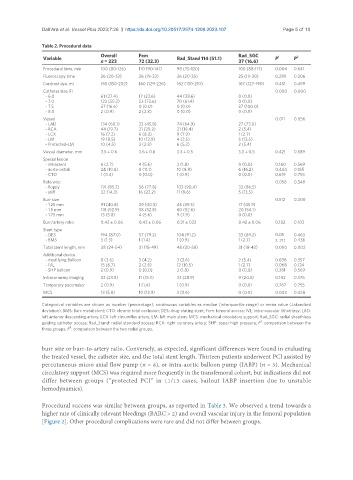
               burr size or burr-to-artery ratio. Conversely, as expected, significant differences were found in evaluating
               the treated vessel, the catheter size, and the total stent length. Thirteen patients underwent PCI assisted by
               percutaneous micro axial flow pump (n = 8), or intra-aortic balloon pump (IABP) (n = 5). Mechanical
               circulatory support (MCS) was required more frequently in the transfemoral cohort, but indications did not
               differ  between  groups  (“protected  PCI”  in  11/13  cases,  bailout  IABP  insertion  due  to  unstable
               hemodynamics).

               Procedural success was similar between groups, as reported in Table 3. We observed a trend towards a
               higher rate of clinically relevant bleedings (BARC > 2) and overall vascular injury in the femoral population
               [Figure 2]. Other procedural complications were rare and did not differ between groups.

