


Page 93 - Read Online
P. 93
Chang et al. Soft Sci. 2026, 6, 29                                                Page 3 of 26


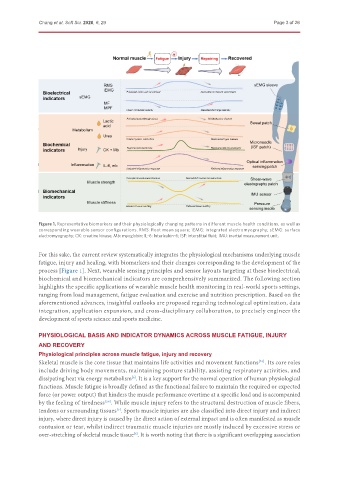
               Figure 1. Representative biomarkers and their physiologically changing patterns in different muscle health conditions, as well as
               corresponding wearable sensor configurations. RMS: Root mean square; iEMG: integrated electromyography; sEMG: surface
               electromyography; CK: creatine kinase; Mb: myoglobin; IL-6: Interleukin-6; ISF: interstitial fluid; IMU: inertial measurement unit.


               For this sake, the current review systematically integrates the physiological mechanisms underlying muscle
               fatigue, injury and healing, with biomarkers and their changes corresponding to the development of the
               process [Figure 1]. Next, wearable sensing principles and sensor layouts targeting at these bioelectrical,
               biochemical and biomechanical indicators are comprehensively summarized. The following section
               highlights the specific applications of wearable muscle health monitoring in real-world sports settings,
               ranging from load management, fatigue evaluation and exercise and nutrition prescription. Based on the
               aforementioned advances, insightful outlooks are proposed regarding technological optimization, data
               integration, application expansion, and cross-disciplinary collaboration, to precisely engineer the
               development of sports science and sports medicine.


               PHYSIOLOGICAL BASIS AND INDICATOR DYNAMICS ACROSS MUSCLE FATIGUE, INJURY
               AND RECOVERY
               Physiological principles across muscle fatigue, injury and recovery
               Skeletal muscle is the core tissue that maintains life activities and movement functions . Its core roles
                                                                                            [25]
               include driving body movements, maintaining posture stability, assisting respiratory activities, and
               dissipating heat via energy metabolism . It is a key support for the normal operation of human physiological
                                               [6]
               functions. Muscle fatigue is broadly defined as the functional failure to maintain the required or expected
               force (or power output) that hinders the muscle performance overtime at a specific load and is accompanied
               by the feeling of tiredness . While muscle injury refers to the structural destruction of muscle fibers,
                                      [26]
               tendons or surrounding tissues . Sports muscle injuries are also classified into direct injury and indirect
                                          [5]
               injury, where direct injury is caused by the direct action of external impact and is often manifested as muscle
               contusion or tear, whilst indirect traumatic muscle injuries are mostly induced by excessive stress or
               over-stretching of skeletal muscle tissue . It is worth noting that there is a significant overlapping association
                                                [6]

