


Page 91 - Read Online
P. 91
Review Article  |  Open Access

                                                 Soft Science


                                           Chang et al. Soft Sci. 2026, 6, 29      DOI:10.20517/ss.2025.132


               Wearable monitoring of muscle health across fatigue,
               injury and recovery in sports


               Ning Chang 1,2,3,# , Dan Wu , Yiming Song , Birui Jin , Lijun Su , Deding Tang 1,2,6,* , Tianqi Yao , Hao Liu 1,2,*
                                   3,#
                                                                                            7,*
                                                          4
                                                                   5
                                                 4,#
               Keywords:
               Muscle fatigue, muscle
               injury and repair, wearable
               monitoring, sports medicine
               Citation: Chang, N.; Wu, D.;
               Song, Y.; Jin, B.; Su, L.;
               Tang, D.; Yao, T.; Liu, H.
               Wearable monitoring of
               muscle health across
               fatigue, injury and recovery
               in sports. Soft Sci. 2026, 6,
               29.
               https://dx.doi.org/10.20517
               /ss.2025.132

               Received: 8 Dec 2025
               First Decision: 30 Jan
               2026                Abstract
               Revised: 18 Jan 2026
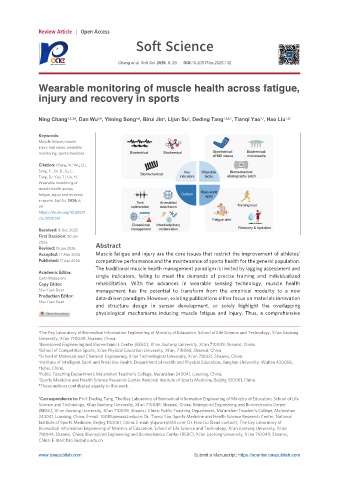
               Accepted: 17 Mar 2026  Muscle fatigue and injury are the core issues that restrict the improvement of athletes’
               Published: 17 Apr 2026  competitive performance and the maintenance of sports health for the general population.
                                   The traditional muscle health management paradigm is limited by lagging assessment and
               Academic Editor:    single   indicators,   failing   to   meet   the   demands   of   precise   training   and   individualized
               Carlo Massaroni
               Copy Editor:        rehabilitation.   With   the   advances   in   wearable   sensing   technology,   muscle   health
               Shu-Yuan Duan       management   has   the   potential   to   transform   from   the   empirical   modality   to   a   new
               Production Editor:  data-driven paradigm. However, existing publications either focus on materials innovation
               Shu-Yuan Duan
                                   and   structure   design   in   sensor   development,   or   solely   highlight   the   overlapping
                                   physiological   mechanisms   inducing   muscle   fatigue   and   injury.   Thus,   a   comprehensive


               1 The Key Laboratory of Biomedical Information Engineering of Ministry of Education, School of Life Science and Technology, Xi’an Jiaotong
               University, Xi’an 710049, Shaanxi, China.
               2 Bioinspired Engineering and Biomechanics Center (BEBC), Xi’an Jiaotong University, Xi’an 710049, Shaanxi, China.
               3 School of Competitive Sports, Xi’an Physical Education University, Xi’an, 710068, Shaanxi, China.
               4 School of Materials and Chemical Engineering, Xi’an Technological University, Xi’an 710021, Shaanxi, China.
               5 Institute of Intelligent Sport and Proactive Health, Department of Health and Physical Education, Jianghan University, Wuhan 430056,
               Hubei, China.
               6 Public Teaching Department, Ma’anshan Teacher’s College, Ma’anshan 243041, Liaoning, China.
               7 Sports Medicine and Health Science Research Center, National Institute of Sports Medicine, Beijing 100061, China.
               # These authors contributed equally to this work.

               * Correspondence to: Prof. Deding Tang, The Key Laboratory of Biomedical Information Engineering of Ministry of Education, School of Life
               Science and Technology, Xi’an Jiaotong University, Xi’an 710049, Shaanxi, China; Bioinspired Engineering and Biomechanics Center
               (BEBC), Xi’an Jiaotong University, Xi’an 710049, Shaanxi, China; Public Teaching Department, Ma’anshan Teacher’s College, Ma’anshan
               243041, Liaoning, China. E-mail: 10085@massz.edu.cn; Dr. Tianqi Yao, Sports Medicine and Health Science Research Center, National
               Institute of Sports Medicine, Beijing 100061, China. E-mail: ytqwork@163.com; Dr. Hao Liu (Lead contact), The Key Laboratory of
               Biomedical Information Engineering of Ministry of Education, School of Life Science and Technology, Xi’an Jiaotong University, Xi’an
               710049, Shaanxi, China; Bioinspired Engineering and Biomechanics Center (BEBC), Xi’an Jiaotong University, Xi’an 710049, Shaanxi,
               China. E-mail: hao.liu@xjtu.edu.cn

               www.oaepublish.com                                    Submit a Manuscript: https://ucenter.oaepublish.com

