


Page 62 - Read Online
P. 62
Kim et al. Soft Sci. 2026, 6, 26                                                   Page 3 of 9


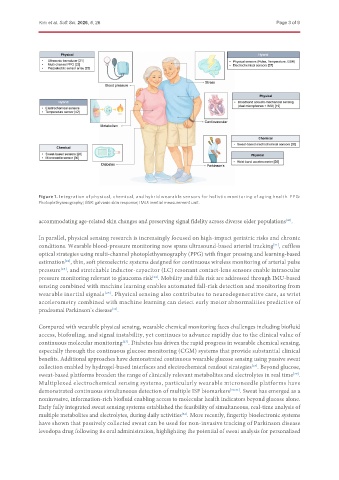
               Figure 1. Integration of physical, chemical, and hybrid wearable sensors for holistic monitoring of aging health. PPG:
               Photoplethysmography; GSR: galvanic skin response; IMU: inertial measurement unit.

               accommodating age-related skin changes and preserving signal fidelity across diverse older populations .
                                                                                                     [20]

               In parallel, physical sensing research is increasingly focused on high-impact geriatric risks and chronic
               conditions. Wearable blood-pressure monitoring now spans ultrasound-based arterial tracking , cuffless
                                                                                                 [21]
               optical strategies using multi-channel photoplethysmography (PPG) with finger pressing and learning-based
               estimation , thin, soft piezoelectric systems designed for continuous wireless monitoring of arterial pulse
                        [22]
               pressure , and stretchable inductor-capacitor (LC) resonant contact-lens sensors enable intraocular
                      [23]
               pressure monitoring relevant to glaucoma risk . Mobility and falls risk are addressed through IMU-based
                                                       [24]
               sensing combined with machine learning enables automated fall-risk detection and monitoring from
               wearable inertial signals . Physical sensing also contributes to neurodegenerative care, as wrist
                                      [25]
               accelerometry combined with machine learning can detect early motor abnormalities predictive of
               prodromal Parkinson’s disease .
                                        [26]
               Compared with wearable physical sensing, wearable chemical monitoring faces challenges including biofluid
               access, biofouling, and signal instability, yet continues to advance rapidly due to the clinical value of
               continuous molecular monitoring . Diabetes has driven the rapid progress in wearable chemical sensing,
                                            [27]
               especially through the continuous glucose monitoring (CGM) systems that provide substantial clinical
               benefits. Additional approaches have demonstrated continuous wearable glucose sensing using passive sweat
               collection enabled by hydrogel-based interfaces and electrochemical readout strategies . Beyond glucose,
                                                                                         [28]
               sweat-based platforms broaden the range of clinically relevant metabolites and electrolytes in real time .
                                                                                                        [29]
               Multiplexed electrochemical sensing systems, particularly wearable microneedle platforms have
               demonstrated continuous simultaneous detection of multiple ISF biomarkers [30,31] . Sweat has emerged as a
               noninvasive, information-rich biofluid enabling access to molecular health indicators beyond glucose alone.
               Early fully integrated sweat sensing systems established the feasibility of simultaneous, real-time analysis of
               multiple metabolites and electrolytes, during daily activities . More recently, fingertip bioelectronic systems
                                                                 [32]
               have shown that passively collected sweat can be used for non-invasive tracking of Parkinson disease
               levodopa drug following its oral administration, highlighting the potential of sweat analysis for personalized

