


Page 123 - Read Online
P. 123
Research Article  |  Open Access

                                                 Soft Science


                                           Chen et al. Soft Sci. 2026, 6, 48      DOI:10.20517/ss.2026.28


               A magnetic balloon fiberbot for catheter-free
               angioplasty in small arteries


               Han Chen , Yuxuan Sun , Han Peng , Yanxun Lin , Nian Zhang , Jiyu Li , Mengli Sui , Chuanxun
                                                                                          1,2
                                              1,2
                                    1,2
                                                                               1,2
                                                                       1,2
                       1,2
                                                           1,2
               Cai , Sipei Ye , Rui Li , Liu Wang 1,2,*
                           1,2
                 1,2
                                  3
               Keywords:
               Magnetic balloon fiberbot,
               catheter-free angioplasty,
               minimally invasive surgery,
               small arteries, wireless
               heating
               Citation: Chen, H.; Sun, Y.;
               Peng, H.; Lin, Y.; Zhang, N.;
               Li, J.; Sui, M.; Cai, C.; Ye, S.;
               Li, R.; Wang, L. A magnetic
               balloon fiberbot for
               catheter-free angioplasty in
               small arteries. Soft Sci. 2026,
               6, 48.
               https://dx.doi.org/10.20517
               /ss.2026.28
               Received: 5 Feb 2026  Abstract
               First Decision: 13 Apr
               2026                Blockages   in   cerebral   arteries   restrict   blood   flow   to   the   brain,   leading   to   several
               Revised: 19 May 2026  life-threatening   conditions   such   as   stroke.   The   standard   treatment,   known   as
               Accepted: 22 May 2026  catheter-assisted   balloon   angioplasty,   involves   threading   a   mechanical   guidewire   and
               Published: 15 Jun 2026
                                   catheter-mounted  balloon  to  the  blockage,  where  the  balloon  is  inflated  to  reopen  the
               Academic Editor:    blocked artery. However, this approach struggles with the limited navigation capability of
               Xing Ma             pre-shaped   guidewires   and   catheters,   especially   in   tortuous   and   small   arteries   with
               Copy Editor:        diameters ≤ 2 mm. Emerging miniature robots offer a potential alternative for catheter-free
               Xing-Yue Zhang
               Production Editor:  angioplasty   via   wirelessly   actuated   expansion.   Still,   they   typically   require   high-power
               Xing-Yue Zhang      electromagnetic   coils   and   short   actuation   distances,   limiting   their   practicality   for
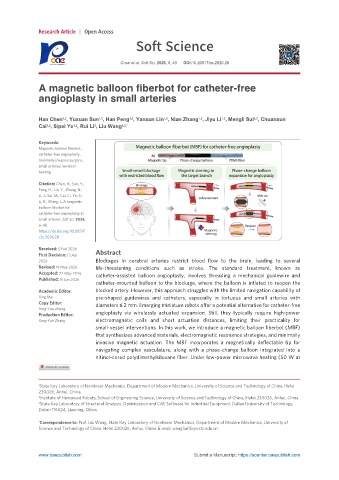
                                   small-vessel interventions. In this work, we introduce a magnetic balloon fiberbot (MBF)
                                   that synthesizes advanced materials, electromagnetic resonance strategies, and minimally
                                   invasive   magnetic   actuation.   The   MBF   incorporates   a   magnetically   deflectable   tip   for
                                   navigating   complex   vasculature,   along   with   a   phase-change   balloon   integrated   into   a
                                   nitinol-cored polydimethylsiloxane fiber. Under low-power microwave heating (50 W at


               1 State Key Laboratory of Nonlinear Mechanics, Department of Modern Mechanics, University of Science and Technology of China, Hefei
               230026, Anhui, China.
               2 Institute of Humanoid Robots, School of Engineering Science, University of Science and Technology of China, Hefei 230026, Anhui, China.
               3 State Key Laboratory of Structural Analysis, Optimization and CAE Software for Industrial Equipment, Dalian University of Technology,
               Dalian 116024, Liaoning, China.

               * Correspondence to: Prof. Liu Wang, State Key Laboratory of Nonlinear Mechanics, Department of Modern Mechanics, University of
               Science and Technology of China, Hefei 230026, Anhui, China. E-mail: wangliu05@ustc.edu.cn


               www.oaepublish.com                                    Submit a Manuscript: https://ucenter.oaepublish.com

