


Page 154 - Read Online
P. 154
Page 44 of 57 Zheng et al. Soft Sci. 2026, 6, 32
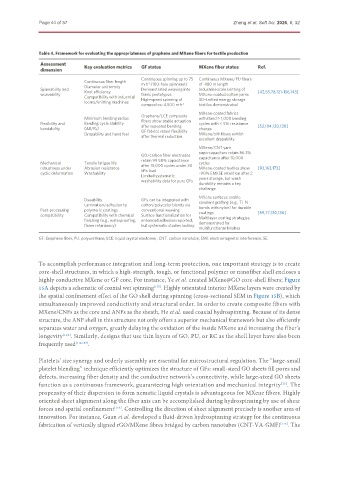
Table 4. Framework for evaluating the appropriateness of graphene and MXene fibers for textile production
Assessment Key evaluation metrics GF status MXene fiber status Ref.
dimension
Continuous spinning up to 75 Continuous MXene/PU fibers
Continuous fiber length m·h (100-hole spinneret) of ~100 m length
-1
Diameter uniformity
Spinnability and Demonstrated weaving into Industrial-scale knitting of
weavability Knot efficiency fabric prototypes MXene-coated cotton yarns [42,53,78,121-136,143]
Compatibility with industrial High-speed spinning of 3D-knitted energy storage
looms/knitting machines
composites: 4,500 m·h -1 textiles demonstrated
MXene-coated fabrics
Graphene/LCE composite
Minimum bending radius withstand > 1,000 bending
Flexibility and Bending cycle stability fibers show stable actuation cycles with < 5% resistance
bendability (ΔR/R0) after repeated bending change [53,104,120,130]
Drapability and hand feel GF fabrics retain flexibility MXene/silk fibers exhibit
after thermal reduction
excellent drapability
MXene/CNT yarn
supercapacitors retain 86.3%
GO/carbon fiber electrodes capacitance after 10,000
retain 99.58% capacitance
Mechanical Tensile fatigue life cycles
robustness under Abrasion resistance after 15,000 cycles under 30 MXene-coated textiles show [93,163,173]
cyclic deformation Washability kPa load ~90% EMI SE retention after 2
Limited systematic years storage, but wash
washability data for pure GFs
durability remains a key
challenge
MXene surfaces enable
Dyeability GFs can be integrated with covalent grafting (e.g., Ti–N
Lamination/adhesion to cotton/polyester blends via bonds with nylon) for durable
Post-processing polymeric coatings conventional weaving coatings [59,77,130,136]
compatibility Compatibility with chemical Surface functionalization for Multilayer coating strategies
finishing (e.g., waterproofing, enhanced adhesion reported, demonstrated for
flame retardancy) but systematic studies lacking
multifunctional finishes
GF: Graphene fiber; PU: polyurethane; LCE: liquid crystal elastomer; CNT: carbon nanotube; EMI: electromagnetic interference; SE:
To accomplish performance integration and long-term protection, one important strategy is to create
core-shell structures, in which a high-strength, tough, or functional polymer or nanofiber shell encloses a
highly conductive MXene or GF core. For instance, Ye et al. created MXene@GO core-shell fibers; Figure
15A depicts a schematic of coaxial wet spinning . Highly orientated interior MXene layers were created by
[175]
the spatial confinement effect of the GO shell during spinning (cross-sectional SEM in Figure 15B), which
simultaneously improved conductivity and structural order. In order to create composite fibers with
MXene/CNFs as the core and ANFs as the sheath, He et al. used coaxial hydrospinning. Because of its dense
structure, the ANF shell in this structure not only offers a superior mechanical framework but also efficiently
separates water and oxygen, greatly delaying the oxidation of the inside MXene and increasing the fiber’s
longevity [122] . Similarly, designs that use thin layers of GO, PU, or RC as the shell layer have also been
frequently used [114,157] .
Platelets’ size synergy and orderly assembly are essential for microstructural regulation. The “large-small
platelet blending” technique efficiently optimizes the structure of GFs: small-sized GO sheets fill pores and
defects, increasing fiber density and the conductive network’s connectivity, while large-sized GO sheets
function as a continuous framework, guaranteeing high orientation and mechanical integrity . The
[15]
propensity of their dispersion to form nematic liquid crystals is advantageous for MXene fibers. Highly
oriented sheet alignment along the fiber axis can be accomplished during hydrospinning by use of shear
forces and spatial confinement [114] . Controlling the direction of sheet alignment precisely is another area of
innovation. For instance, Guan et al. developed a fluid-driven hydrospinning strategy for the continuous
fabrication of vertically aligned rGO/MXene fibres bridged by carbon nanotubes (CNT-VA-GMF) [176] . The

