


Page 147 - Read Online
P. 147
Zheng et al. Soft Sci. 2026, 6, 32                                               Page 37 of 57


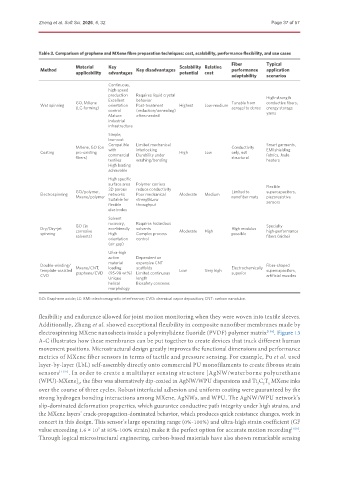
               Table 3. Comparison of graphene and MXene fibre preparation techniques: cost, scalability, performance flexibility, and use cases
                                                                                  Fiber        Typical
                            Material   Key                      Scalability Relative
               Method                            Key disadvantages                performance  application
                            applicability  advantages           potential  cost
                                                                                  adaptability  scenarios
                                       Continuous,
                                       high-speed
                                       production  Requires liquid crystal
                                       Excellent  behavior                                     High-strength
                            GO, MXene                                             Tunable from  conductive fibers,
               Wet spinning            orientation  Post-treatment  Highest  Low-medium
                            (LC-forming)                                          aerogel to dense  energy storage
                                       control   (reduction/annealing)
                                       Mature    often needed                                  yarns
                                       industrial
                                       infrastructure
                                       Simple,
                                       low-cost
                                       Compatible  Limited mechanical                          Smart garments,
                            MXene, GO (on  with  interlocking                     Conductivity  EMI shielding
               Coating      pre-existing  commercial  Durability under  High  Low  only, not   fabrics, Joule
                            fibers)                                               structural
                                       textiles  washing/bending                               heaters
                                       High loading
                                       achievable
                                       High specific
                                       surface area  Polymer carriers
                                       3D porous  reduce conductivity                          Flexible
                            GO/polymer,                                           Limited to   supercapacitors,
               Electrospinning         networks  Poor mechanical  Moderate  Medium
                            Mxene/polymer                                         nanofiber mats  piezoresistive
                                       Suitable for  strengthLow
                                       flexible  throughput                                    sensors
                                       electrodes
                                       Solvent
                                       recovery,  Requires hazardous
                            GO (in                                                             Specialty
               Dry/Dry-jet             eco-friendly  solvents                     High modulus
               spinning     corrosive  High      Complex process  Moderate  High  possible     high-performance
                            solvents)                                                          fibers (niche)
                                       orientation  control
                                       (air gap)
                                       Ultra-high
                                       active    Dependent on
                                       material  expensive CNT
               Double-winding/  Mxene/CNT,  loading  scaffolds                    Electrochemically  Fiber-shaped
               template-assisted  graphene/CVD  (95-98 wt%) Limited continuous  Low  Very high  superior  supercapacitors,
               CVD                                                                             artificial muscles
                                       Unique    length
                                       helical   Biosafety concerns
                                       morphology
               GO: Graphene oxide; LC: EMI: electromagnetic interference; CVD: chemical vapor deposition; CNT: carbon nanotube.

               flexibility and endurance allowed for joint motion monitoring when they were woven into textile sleeves.
               Additionally, Zhang et al. showed exceptional flexibility in composite nanofiber membranes made by
               electrospinning MXene nanosheets inside a polyvinylidene fluoride (PVDF) polymer matrix [158] . Figure 13
               A-C illustrates how these membranes can be put together to create devices that track different human
               movement positions. Microstructural design greatly improves the functional dimensions and performance
               metrics of MXene fiber sensors in terms of tactile and pressure sensing. For example, Pu et al. used
               layer-by-layer (LbL) self-assembly directly onto commercial PU monofilaments to create fibrous strain
               sensors [159] . In order to create a multilayer sensing structure [AgNW/waterborne polyurethane
               (WPU)-MXene] , the fiber was alternatively dip-coated in AgNW/WPU dispersions and Ti C T  MXene inks
                                                                                           3 2 x
                             3
               over the course of three cycles. Robust interfacial adhesion and uniform coating were guaranteed by the
               strong hydrogen bonding interactions among MXene, AgNWs, and WPU. The AgNW/WPU network’s
               slip-dominated deformation properties, which guarantee conductive path integrity under high strains, and
               the MXene layers’ crack-propagation-dominated behavior, which produces quick resistance changes, work in
               concert in this design. This sensor’s large operating range (0%-100%) and ultra-high strain coefficient (GF
               value exceeding 1.6 × 10  at 85%-100% strain) make it the perfect option for accurate motion recording [159] .
                                   7
               Through logical microstructural engineering, carbon-based materials have also shown remarkable sensing

