


Page 117 - Read Online
P. 117
Zhang et al. Soft Sci 2024;4:23  https://dx.doi.org/10.20517/ss.2023.58         Page 11 of 21


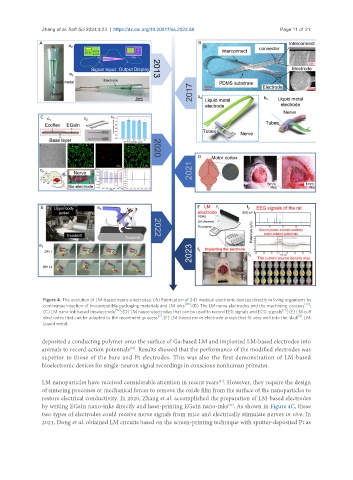
                Figure 4. The evolution of LM-based neuro-electrodes. (A) Fabrication of 3-D medical electronic devices directly in living organisms by
                continuous injection of biocompatible packaging materials and LM inks [90] ; (B) The LM nerve electrodes and the machining process [73] ;
                (C) LM nano-ink based bioelectrode [92] ; (D) LM neuro-electrodes that can be used to record EEG signals and ECG signals [77] ; (E) LM cuff
                                                      [7]                                             [9]
                electrodes that can be adapted to the movement process ; (F) LM-based nerve electrode arrays that fit very well into the skull . LM:
                Liquid metal.

               deposited a conducting polymer onto the surface of Ga-based LM and implanted LM-based electrodes into
                                             [81]
               animals to record action potentials . Results showed that the performance of the modified electrodes was
               superior to those of the bare and Pt electrodes. This was also the first demonstration of LM-based
               bioelectronic devices for single-neuron signal recordings in conscious nonhuman primates.


               LM nanoparticles have received considerable attention in recent years . However, they require the design
                                                                           [91]
               of sintering processes or mechanical forces to remove the oxide film from the surface of the nanoparticles to
               restore electrical conductivity. In 2020, Zhang et al. accomplished the preparation of LM-based electrodes
               by writing EGaIn nano-inks directly and laser-printing EGaIn nano-inks . As shown in Figure 4C, these
                                                                              [92]
               two types of electrodes could receive nerve signals from mice and electrically stimulate nerves in vivo. In
               2021, Dong et al. obtained LM circuits based on the screen-printing technique with sputter-deposited Pt as

