


Page 32 - Read Online
P. 32
Page 4 of 38                             Wei et al. Soft Sci 2023;3:17  https://dx.doi.org/10.20517/ss.2023.09


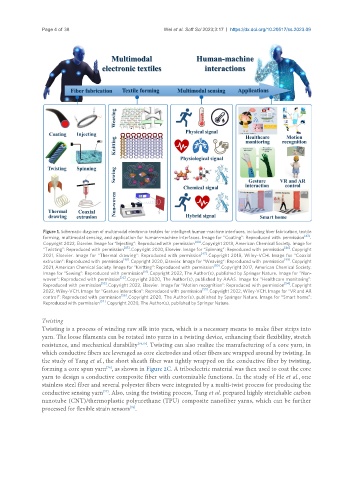
                Figure 1. Schematic diagram of multimodal electronic textiles for intelligent human-machine interfaces, including fiber fabrication, textile
                                                                                                        [43]
                forming, multimodal sensing, and application for human-machine interfaces. Image for “Coating”: Reproduced with  permission  .
                                                                   [44]
                Copyright 2022, Elsevier. Image for “Injecting”: Reproduced with permission  . Copyright 2018, American Chemical Society. Image for
                                           [45]                                                  [46]
                “Twisting”: Reproduced with permission  . Copyright 2020, Elsevier. Image for “Spinning”: Reproduced with permission  . Copyright
                                                                     [47]
                2021, Elsevier. Image for “Thermal drawing”: Reproduced with  permission  . Copyright 2018, Wiley-VCH. Image for “Coaxial
                                           [48]                                                  [49]
                extrusion”: Reproduced with permission  . Copyright 2020, Elsevier. Image for “Weaving”: Reproduced with permission  . Copyright
                2021, American Chemical Society. Image for “Knitting”: Reproduced with  permission [50] . Copyright 2017, American Chemical Society.
                Image for “Sewing”: Reproduced with  permission [51] . Copyright 2022, The Author(s), published by Springer Nature. Image for “Non-
                woven”: Reproduced with  permission [52] . Copyright 2020, The Author(s), published by AAAS. Image for “Healthcare monitoring”:
                Reproduced with  permission [53] . Copyright 2022, Elsevier. Image for “Motion recognition”: Reproduced with  permission [54] . Copyright
                2022, Wiley-VCH. Image for “Gesture interaction”: Reproduced with permission [55] . Copyright 2022, Wiley-VCH. Image for “VR and AR
                control”: Reproduced with  permission [56] . Copyright 2020, The Author(s), published by Springer Nature. Image for “Smart home”:
                Reproduced with permission [57] . Copyright 2020, The Author(s), published by Springer Nature.
               Twisting
               Twisting is a process of winding raw silk into yarn, which is a necessary means to make fiber strips into
               yarn. The loose filaments can be rotated into yarns in a twisting device, enhancing their flexibility, stretch
               resistance, and mechanical durability [74,75] . Twisting can also realize the manufacturing of a core yarn, in
               which conductive fibers are leveraged as core electrodes and other fibers are wrapped around by twisting. In
               the study of Yang et al., the short sheath fiber was tightly wrapped on the conductive fiber by twisting,
               forming a core spun yarn , as shown in Figure 2C. A triboelectric material was then used to coat the core
                                     [76]
               yarn to design a conductive composite fiber with customizable functions. In the study of He et al., one
               stainless steel fiber and several polyester fibers were integrated by a multi-twist process for producing the
               conductive sensing yarn . Also, using the twisting process, Tang et al. prepared highly stretchable carbon
                                    [77]
               nanotube (CNT)/thermoplastic polyurethane (TPU) composite nanofiber yarns, which can be further
               processed for flexible strain sensors .
                                             [78]

