


Page 54 - Read Online
P. 54
Jung et al. Soft Sci 2024;4:15  https://dx.doi.org/10.20517/ss.2024.02          Page 33 of 44

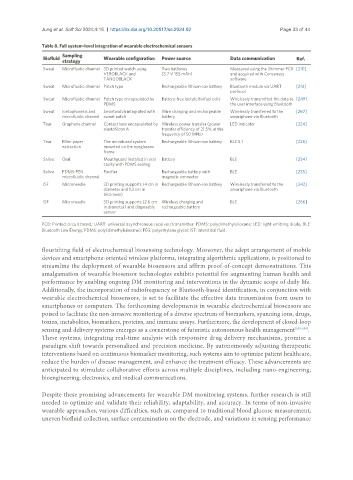
               Table 8. Full system-level integration of wearable electrochemical sensors
                      Sampling
                Biofluid            Wearable configuration  Power source       Data communication    Ref.
                      strategy
                Sweat  Microfluidic channel 3D printed watch using   Two batteries   Measured using the Shimmer PCB  [210]
                                    VEROBLACK and       (3.7 V 155 mAh)        and acquired with Consensys
                                    TANGOBLACK                                 software
                Sweat  Microfluidic channel Patch type  Rechargeable lithium-ion battery  Bluetooth module via UART   [214]
                                                                               protocol
                Sweat  Microfluidic channel Patch type encapsulated by   Battery-free lactate biofuel cells  Wirelessly transmitted the data to  [249]
                                    PDMS                                       the user interface using Bluetooth
                Sweat  Iontophoresis and   Smartwatch integrated with   Wire charging and rechargeable   Wirelessly transferred to the   [267]
                      microfluidic channel sweat patch  battery                smartphone via Bluetooth
                Tear  Graphene channel  Contact lens encapsulated by  Wireless power transfer (power   LED indicator  [224]
                                    elastofilcon A      transfer efficiency of 21.5% at the
                                                        frequency of 50 MHz)
                Tear  Filter paper   The miniatured system   Rechargeable lithium-ion battery  BLE 5.1  [226]
                      extraction    mounted on the eyeglasses
                                    frame
                Saliva  Oral        Mouthguard installed in oral   Battery     BLE                   [234]
                                    cavity with PDMS sealing
                Saliva  PDMS-PEG    Pacifier            Rechargeable battery with   BLE              [235]
                      microfluidic channel              magnetic connector
                ISF   Microneedle   3D printing supports (4 cm in  Rechargeable lithium-ion battery  Wirelessly transferred to the   [242]
                                    diameter and 1.2 cm in                     smartphone via Bluetooth
                                    thickness)
                ISF   Microneedle   3D printing supports (2.6 cm  Wireless charging and   BLE        [266]
                                    in diameter) and disposable   rechargeable battery
                                    sensor

               PCB: Printed circuit board; UART: universal asynchronous receiver/transmitter; PDMS: polydimethylsiloxane; LED: light emitting diode; BLE:
               Bluetooth Low Energy; PDMS: poly(dimethylsiloxane); PEG: polyethylene glycol; ISF: interstitial fluid .


               flourishing field of electrochemical biosensing technology. Moreover, the adept arrangement of mobile
               devices and smartphone-oriented wireless platforms, integrating algorithmic applications, is positioned to
               streamline the deployment of wearable biosensors and affirm proof-of-concept demonstrations. This
               amalgamation of wearable biosensor technologies exhibits potential for augmenting human health and
               performance by enabling ongoing DM monitoring and interventions in the dynamic scope of daily life.
               Additionally, the incorporation of radiofrequency or Bluetooth-based identification, in conjunction with
               wearable electrochemical biosensors, is set to facilitate the effective data transmission from users to
               smartphones or computers. The forthcoming developments in wearable electrochemical biosensors are
               poised to facilitate the non-invasive monitoring of a diverse spectrum of biomarkers, spanning ions, drugs,
               toxins, metabolites, biomarkers, proteins, and immune assays. Furthermore, the development of closed-loop
               sensing and delivery systems emerges as a cornerstone of futuristic autonomous health management [283-285] .
               These systems, integrating real-time analysis with responsive drug delivery mechanisms, promise a
               paradigm shift towards personalized and precision medicine. By autonomously adjusting therapeutic
               interventions based on continuous biomarker monitoring, such systems aim to optimize patient healthcare,
               reduce the burden of disease management, and enhance the treatment efficacy. These advancements are
               anticipated to stimulate collaborative efforts across multiple disciplines, including nano-engineering,
               bioengineering, electronics, and medical communications.

               Despite these promising advancements for wearable DM monitoring systems, further research is still
               needed to optimize and validate their reliability, adaptability, and accuracy. In terms of non-invasive
               wearable approaches, various difficulties, such as, compared to traditional blood glucose measurement,
               uneven biofluid collection, surface contamination on the electrode, and variations in sensing performance

