


Page 7 - Read Online
P. 7
Brown. Rare Dis Orphan Drugs J. 2025;4:21  https://dx.doi.org/10.20517/rdodj.2025.14  Page 3 of 15


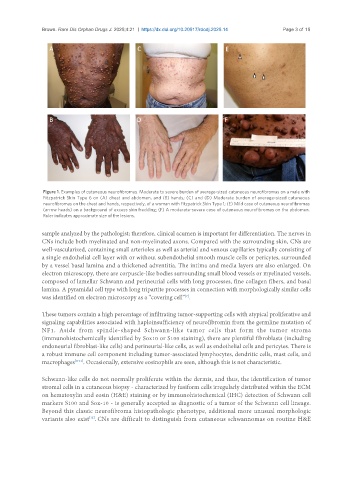
                Figure 1. Examples of cutaneous neurofibromas. Moderate to severe burden of average-sized cutaneous neurofibromas on a male with
                Fitzpatrick Skin Type 6 on (A) chest and abdomen, and (B) hands; (C) and (D) Moderate burden of average-sized cutaneous
                neurofibromas on the chest and hands, respectively, of a woman with Fitzpatrick Skin Type 1; (E) Mild case of cutaneous neurofibromas
                (arrow heads) on a background of excess skin freckling; (F) A moderate-severe case of cutaneous neurofibromas on the abdomen.
                Ruler indicates approximate size of the lesions.

               sample analyzed by the pathologist; therefore, clinical acumen is important for differentiation. The nerves in
               CNs include both myelinated and non-myelinated axons. Compared with the surrounding skin, CNs are
               well-vascularized, containing small arterioles as well as arterial and venous capillaries typically consisting of
               a single endothelial cell layer with or without subendothelial smooth muscle cells or pericytes, surrounded
               by a vessel basal lamina and a thickened adventitia. The intima and media layers are also enlarged. On
               electron microscopy, there are corpuscle-like bodies surrounding small blood vessels or myelinated vessels,
               composed of lamellar Schwann and perineurial cells with long processes, fine collagen fibers, and basal
               lamina. A pyramidal cell type with long tripartite processes in connection with morphologically similar cells
                                                               [7]
               was identified on electron microscopy as a “covering cell” .
               These tumors contain a high percentage of infiltrating tumor-supporting cells with atypical proliferative and
               signaling capabilities associated with haploinsufficiency of neurofibromin from the germline mutation of
               NF1.  Aside  from  spindle-shaped  Schwann-like  tumor  cells  that  form  the  tumor  stroma
               (immunohistochemically identified by Sox10 or S100 staining), there are plentiful fibroblasts (including
               endoneurial fibroblast-like cells) and perineurial-like cells, as well as endothelial cells and pericytes. There is
               a robust immune cell component including tumor-associated lymphocytes, dendritic cells, mast cells, and
               macrophages [8-11] . Occasionally, extensive eosinophils are seen, although this is not characteristic.


               Schwann-like cells do not normally proliferate within the dermis, and thus, the identification of tumor
               stromal cells in a cutaneous biopsy - characterized by fusiform cells irregularly distributed within the ECM
               on hematoxylin and eosin (H&E) staining or by immunohistochemical (IHC) detection of Schwann cell
               markers S100 and Sox-10 - is generally accepted as diagnostic of a tumor of the Schwann cell lineage.
               Beyond this classic neurofibroma histopathologic phenotype, additional more unusual morphologic
               variants also exist . CNs are difficult to distinguish from cutaneous schwannomas on routine H&E
                               [12]

