


Page 41 - Read Online
P. 41
Page 2 of 8                                                Kim et al. Rare Dis Orphan Drugs J. 2026;5:6


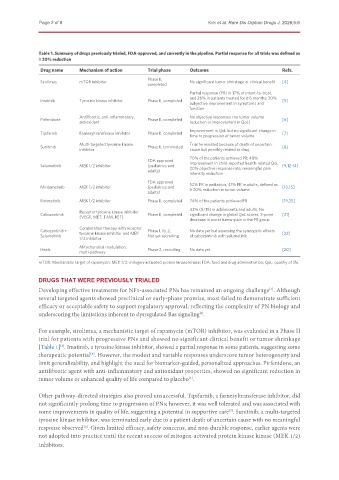
               Table 1. Summary of drugs previously trialed, FDA-approved, and currently in the pipeline. Partial response for all trials was defined as
               ≥ 20% reduction

               Drug name     Mechanism of action     Trial phase    Outcome                         Refs.
                                                     Phase II,
               Sirolimus     mTOR inhibitor                         No significant tumor shrinkage or clinical benefit  [4]
                                                     completed
                                                                    Partial response (PR) in 17% of intent-to-treat,
                                                                    and 26% in patients treated for ≥ 6 months; 30%
               Imatinib      Tyrosine kinase inhibitor  Phase II, completed                         [5]
                                                                    subjective improvement in symptoms and
                                                                    function
                             Antifibrotic, anti-inflammatory,       No objective responses (no tumor volume
               Pirfenidone                           Phase II, completed                            [6]
                             antioxidant                            reduction or improvement in QoL)
                                                                    Improvement in QoL but no significant change in
               Tipifarnib    Farnesyltransferase inhibitor  Phase II, completed                     [7]
                                                                    time to progression of tumor volume
                             Multi-targeted tyrosine kinase         Trial terminated because of death of uncertain
               Sunitinib                             Phase II, terminated                           [8]
                             inhibitor                              cause but possibly related to drug
                                                                    70% of the patients achieved PR; 48%
                                                     FDA approved
               Selumetinib   MEK 1/2 inhibitor       (pediatrics and  improvement in child-reported health-related QoL  [9,12-14]
                                                     adults)        20% objective response rate; meaningful pain
                                                                    intensity reduction
                                                     FDA approved   52% PR in pediatrics, 41% PR in adults, defined as
               Mirdametinib  MEK 1/2 inhibitor       (pediatrics and  ≥ 20% reduction in tumor volume  [10,15]
                                                     adults)
               Binimetinib   MEK 1/2 inhibitor       Phase II, completed  74% of the patients achieved PR  [19,25]
                                                                    42% (8/19) in adolescents and adults; No
                             Receptor tyrosine kinase inhibitor
               Cabozantinib                          Phase II, completed  significant change in global QoL scores; 3-point  [21]
                             (VEGF, MET, TAM, RET)
                                                                    decrease in worst tumor-pain in the PR group
                             Combination therapy with receptor
               Cabozantinib +                        Phase I, Ib, 2;  No data yet but assessing the synergistic effects
               Selumetinib   tyrosine kinase inhibitor and MEK  Not yet recruiting  of cabozantinib with selumetinib  [22]
                             1/2 inhibitor
                             Mitochondrial modulation,
               Healx                                 Phase 2, recruiting  No data yet               [20]
                             multi-pathway
               mTOR: Mechanistic target of rapamycin; MEK 1/2: mitogen-activated protein kinase kinase; FDA: food and drug administration; QoL: qualitiy of life.

               DRUGS THAT WERE PREVIOUSLY TRIALED
               Developing effective treatments for NF1-associated PNs has remained an ongoing challenge . Although
                                                                                                [3]
               several targeted agents showed preclinical or early-phase promise, most failed to demonstrate sufficient
               efficacy or acceptable safety to support regulatory approval, reflecting the complexity of PN biology and
               underscoring the limitations inherent to dysregulated Ras signaling .
                                                                       [3]

               For example, sirolimus, a mechanistic target of rapamycin (mTOR) inhibitor, was evaluated in a Phase II
               trial for patients with progressive PNs and showed no significant clinical benefit or tumor shrinkage
               [Table 1] . Imatinib, a tyrosine kinase inhibitor, showed a partial response in some patients, suggesting some
                      [4]
               therapeutic potential . However, the modest and variable responses underscore tumor heterogeneity and
                                 [5]
               limit generalizability, and highlight the need for biomarker-guided, personalized approaches. Pirfenidone, an
               antifibrotic agent with anti-inflammatory and antioxidant properties, showed no significant reduction in
               tumor volume or enhanced quality of life compared to placebo .
                                                                   [6]

               Other pathway-directed strategies also proved unsuccessful. Tipifarnib, a farnesyltransferase inhibitor, did
               not significantly prolong time to progression of PNs; however, it was well tolerated and was associated with
               some improvements in quality of life, suggesting a potential in supportive care . Sunitinib, a multi-targeted
                                                                                 [7]
               tyrosine kinase inhibitor, was terminated early due to a patient death of uncertain cause with no meaningful
               response observed . Given limited efficacy, safety concerns, and non-durable response, earlier agents were
                              [8]
               not adopted into practice until the recent success of mitogen-activated protein kinase kinase (MEK 1/2)

               inhibitors.

