


Page 63 - Read Online
P. 63
Page 4 of 16                                                        Oliver et al. Plast Aesthet Res. 2025;12:19  https://dx.doi.org/10.20517/2347-9264.2025.11

                       revision - peritoneal
                       flap)
                Huang   Mixed          Retrospective chart   19   6.5 ± 4.0 SD  408.6 ± 111.9  Depth: 13.1 ± 3.0 SD (intra-  Wound dehiscence: 7 (36.8%), urethral injury: 3 (15.8%), bladder
                et al.   (Primary or revision   review                                op),               injury: 2 (10.5%) neovaginal stenosis: 4 (21.1%), urethral fistula: 2
                   [16]
                2022   peritoneal flap NOS)                                           11.0 cm ± 4.0 SD (at last   (8.7%), recto-neovaginal fistula: 1 (4.3%), perianal fistula: 1 (4.3%),
                                                                                      follow-up)         clitoral prolapse: 1 (4.3%)
                Johnston   Mixed       Retrospective cohort   33  16        406       Depth: 17 (intra-op),   Neovaginal stenosis: 12 (36%),
                et al.   (Primary or revision   study             (range 4.4-  (IQR 154-220) 11 (at last follow-up)  Fever/UTI: 4 (12%), vaginitis: 2 (6%), blood transfusion: 2 (6%),
                   [10]
                2025   tubularized single                         26.9)                                  VTE: 1 (3%), urinary retention: 3 (9%), labial hematoma: 1 (3%),
                       peritoneal flap ± penile                                                          flap dehiscence: 1 (3%)
                       inversion)
                Dy et al.   Revision   Case series    24          13.2 (range   279.5 (range   Depth: 13.6 (range 10.9-14.5),  Bleeding requiring reoperation for hemostasis: 1 (4.2%), curettage of
                2021 [17]  (peritoneal flap)                      5.7-22.2)  183-443)  Width: 3.6 (range 2.9-3.8)  granulation tissue: 2 (8.3%), de novo SUI 1 (4.2%)
                Smith   Revision (single-  Retrospective chart   10  18.3 ± 14 SD   -  15.1 (SD 2.2) immediately   Anastomotic stricture: 1 (10%), temporary LUTS: 3 (30%)
                et al.   pedicled urachus   review                (range 1.2-         post-op, 12.5 (SD 2.1) at
                   [18]
                2022   peritoneal hinge flap)                     39.4)               median follow-up
               SD: Standard deviation; IQR: interquartile range; NOS: not otherwise specified; UTI: urinary tract infection; LUTS: lower urinary tract symptoms; UUI: urgency urinary incontinence; VTE: venous thromboembolism;
               SUI: stress urinary incontinence.


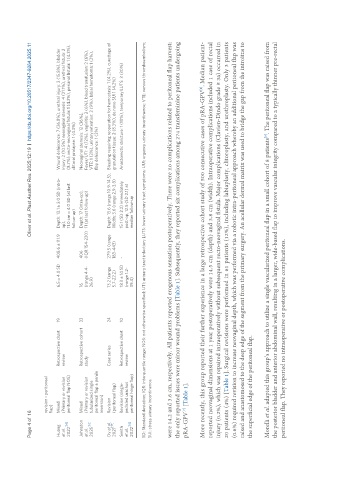
               were 14.2 and 3.6 cm, respectively. All patients reported erogenous sensation postoperatively. There were no complications related to peritoneal flap harvest;
               the only reported issues were minor wound problems [Table 1]. Subsequently, they reported six complications among 274 transfeminine patients undergoing
               pRA-GPV  [Table 1].
                        [7]

                                                                                                                                    [8]
               More recently, this group reported their further experience in a large retrospective cohort study of 500 consecutive cases of pRA-GPV . Median patient-
               reported neovaginal dimensions at 1 year postoperatively were 14.5 cm (depth) and 3.8 cm (width). Intraoperative complications included 1 case of rectal
               injury (0.2%), which was repaired intraoperatively without subsequent recto-neovaginal fistula. Major complications (Clavien-Dindo grade ≥ 3a) occurred in
               20 patients (4%) [Table 1]. Surgical revisions were performed in 61 patients (12%), including labiaplasty, clitoroplasty, and urethroplasty. Only 3 patients
               (0.6%) required revision to increase neovaginal depth, which was performed via a robotic intra-peritoneal approach whereby an additional peritoneal flap was
               raised and anastomosed to the deep edge of the segment from the primary surgery. An acellular dermal matrix was used to bridge the gap from the introitus to
               the superficial edge of the peritoneal flap.


                                                                                                                    [9]
               Morelli et al. adapted this group’s approach to utilize a single vascularized peritoneal flap in a small cohort of 8 patients . The peritoneal flap was raised from
               the posterior bladder and anterior abdominal wall, resulting in a larger, wide-based flap to improve vascular integrity compared to a typically thinner pre-rectal
               peritoneal flap. They reported no intraoperative or postoperative complications.

