


Page 62 - Read Online
P. 62
Oliver et al. Plast Aesthet Res. 2025;12:19  https://dx.doi.org/10.20517/2347-9264.2025.11                                  Page 3 of 16

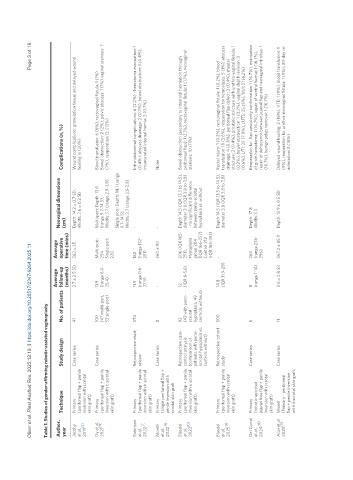
               Table 1. Studies of gender-affirming robotic-assisted vaginoplasty
                                                                  Average   Average
                Author,                                                               Neovaginal dimensions
                year   Technique       Study design   No. of patients follow-up   operative   (cm)       Complications (n, %)
                                                                  (months)
                                                                            time (mins)
                Jacoby   Primary       Case series    41          3.7 ± 2.5 SD  262 ± 35  Depth: 14.2 ± 0.7 SD,   Wound complications: granulation tissue and delayed wound
                et al.   (peritoneal flap + penile                                    Width: 3.6 ± 0.2 SD  healing in (20%)
                2019 [5]  inversion with scrotal
                       skin graft)
                Dy et al.   Primary    Case series    100         11.9      Multi-port:   Multi-port: Depth: 13.6   Blood transfusion: 6 (6%), rectovaginal fistula: 1 (1%)
                   [12]
                2021   (peritoneal flap + penile      (47 multi-port,   (range 6.0-  254   (range 9.7-14.5),   Bowel obstruction: 2 (2%), pelvic abscess: 1 (1%) vaginal stenosis: 7
                       inversion with ± scrotal       53 single-port)  25.4)  Single port:   Width: 3.7 (range 2.9-3.8)   (7%), reoperation 13: (13%)
                       skin graft)                                          220
                                                                                      Single port: Depth: 14.1 (range
                                                                                      9.7-14.5),
                                                                                      Width: 3.7 (range 3.5-3.8)
                Robinson   Primary     Retrospective chart   274  11.9      180       -                  Intra-abdominal complications: 6 (2.2%) - hematoma evacuation: 1
                et al.   (peritoneal flap + penile  review        (range 0.6-  (range 132-               (0.4%), abscess drainage: 2 (0.7%), bowel obstruction: 1 (0.4%),
                2022 [7]  inversion with ± scrotal                37.9)     251)                         incarcerated internal hernia: 2 (0.7%)
                       skin graft)
                Morelli   Primary      Case series    8           -         360 ± 90  -                  None
                et al.   (single peritoneal flap +
                   [9]
                2022   penile inversion with
                       scrotal skin graft
                Blasdel   Primary      Retrospective case-  92    12        206 (IQR 165- Depth 14.5 (IQR 13.3 to 14.5),  Bowel obstruction (secondary to intestinal herniation through
                et al.   (peritoneal flap + penile  control analysis   (43 with peno-  (IQR 6-5.6)  251),   diameter 3.8 (IQR 3.8 to 3.8)  peritoneal flap): 1 (1.1%), rectovaginal fistula: 1 (1.1%), neovaginal
                   [13]
                2023   inversion with ± scrotal  (comparison of   scrotal   Hypoplasia   - no significant difference   stenosis: 10 (11%)
                       skin graft)     patients with peno-  hypoplasia, 49   group 204   between peno-scrotal
                                       scrotal hypoplasia vs.  controls without)  (IQR 166-237)  hypoplasia vs. without
                                       controls without)                    Control 212
                                                                            (IQR 165-253)
                Blasdel   Primary      Retrospective cohort   500  14.8     -         Depth 14.5 (IQR 13.3 to 14.5),  Rectal injury: 1 (0.2%), rectovaginal fistula: 1 (0.2%), blood
                et al.   (peritoneal flap + penile  study         (IQR 11.9-28)       diameter 3.8 (IQR 3.8 to 3.8)  transfusion: 18 (3.6%), reoperation for hemostasis: 5 (1%), abscess
                   [8]
                2025   inversion with scrotal                                                            drainage: 4 (0.8%), peritoneal flap defect: 2 (0.4%), meatal
                       skin graft)                                                                       stricture: 2 (0.4%), prostatic stricture with urethra-vaginal fistula: 1
                                                                                                         (0.2%), bowel obstruction: 1 (0.2%), vaginal depth revision: 3
                                                                                                         (0.6%), UTI: 39 (7.8%), LUTS: 25 (5%), UUI: 31 (6.2%)
                Del Corral  Primary    Case series    6           8         263       Depth: 17.8        Reoperation for: flap vascularity confirmation: 1 (16.7%), evacuation
                et al.   (robotic-assisted                        (range 1-14)  (range 236-  Width: 3.3  of groin hematoma: 1 (16.7%), repair of ventral hernia: 1 (16.7%),
                   [19]
                2024   jejunal free flap + penile                           296)                         repair of dehiscence between jejunal flap and neovaginal introitus: 1
                       inversion with scrotal                                                            (16.7%), benign polyp removal: 1 (16.7%)
                       skin graft)
                Acar et al.   Mixed    Case series    11          2.6 ± 2.8 SD  267.2 ± 85.9  Depth: 13.9 ± 0.5 SD  Delayed wound healing: 2 (18%), VTE: 1 (9%), blood transfusion: 1
                   [11]
                2020   (Primary - peritoneal                                                             (9%), reoperation for urethra-neovaginal fistula: 1 (9%), 30-day re-
                       flap + penile inversion                                                           admission: 2 (18%)
                       with ± scrotal skin graft;

