


Page 54 - Read Online
P. 54
Hart et al. Plast Aesthet Res. 2026;13:3                                          Page 5 of 10


               Yes                                                                108 (91.5)
               No, I plan to have this surgery somewhere other than OHSU          10 (8.5)
               (Missing/no response)                                              0 (0.0)
               VA: Department of Veterans Affairs; TRICARE: health care program for uniformed service members and their families; OHSU: Oregon Health &
               Science University.


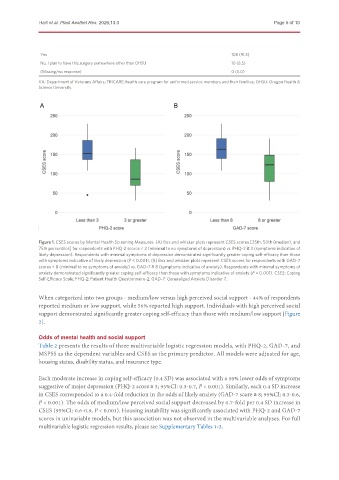
               Figure 1. CSES scores by Mental Health Screening Measures. (A) Box and whisker plots represent CSES scores [25th, 50th (median), and
               75th percentiles] for respondents with PHQ-2 scores < 3 (minimal to no symptoms of depression) vs. PHQ-2 ≥ 3 (symptoms indicative of
               likely depression). Respondents with minimal symptoms of depression demonstrated significantly greater coping self-efficacy than those
               with symptoms indicative of likely depression (P < 0.001); (B) Box and whisker plots represent CSES scores for respondents with GAD-7
               scores < 8 (minimal to no symptoms of anxiety) vs. GAD-7 ≥ 8 (symptoms indicative of anxiety). Respondents with minimal symptoms of
               anxiety demonstrated significantly greater coping self-efficacy than those with symptoms indicative of anxiety (P < 0.001). CSES: Coping
               Self-Efficacy Scale; PHQ-2: Patient Health Questionnaire-2; GAD-7: Generalized Anxiety Disorder 7.


               When categorized into two groups - medium/low versus high perceived social support - 44% of respondents
               reported medium or low support, while 56% reported high support. Individuals with high perceived social
               support demonstrated significantly greater coping self-efficacy than those with medium/low support [Figure
               2].


               Odds of mental health and social support
               Table 2 presents the results of three multivariable logistic regression models, with PHQ-2, GAD-7, and
               MSPSS as the dependent variables and CSES as the primary predictor. All models were adjusted for age,
               housing status, disability status, and insurance type.


               Each moderate increase in coping self-efficacy (0.4 SD) was associated with a 50% lower odds of symptoms
               suggestive of major depression (PHQ-2 score ≥ 3; 95%CI: 0.3-0.7, P < 0.001). Similarly, each 0.4 SD increase
               in CSES corresponded to a 0.4-fold reduction in the odds of likely anxiety (GAD-7 score ≥ 8; 95%CI: 0.3-0.6,
               P < 0.001). The odds of medium/low perceived social support decreased by 0.7-fold per 0.4 SD increase in
               CSES (95%CI: 0.6-0.9, P < 0.001). Housing instability was significantly associated with PHQ-2 and GAD-7
               scores in univariable models, but this association was not observed in the multivariable analyses. For full
               multivariable logistic regression results, please see Supplementary Tables 1-3.

