


Page 44 - Read Online
P. 44
Page 8 of 13             Bencic et al. Plast Aesthet Res. 2025;12:30  https://dx.doi.org/10.20517/2347-9264.2025.38

               Table 2. Patient characteristics
                Patient characteristics and procedural variables                           Values
                Median (IQR) age, years                                                    34.3 (23-58)
                Median (IQR) follow-up, months                                             21 (4-36)
                Comorbidities, n (%)
                - Smoking                                                                  4 (20)
                - Diabetes                                                                 1 (5)
                Type of neophalloplasty, n (%)
                - MLD free flap                                                            20 (100)
                Prosthesis Implanted, n (%)
                - Malleable ZSI 100 FTM                                                    15 (75)
                - Inflatable ZSI 475 FTM                                                   5 (25)
                Prior erectile device, n (%)
                - AMS Ambicor                                                              1 (5)
                Median (IQR) time between neophalloplasty and implantation, months         44 (6-120)
               IQR: Interquartile range; MLD: musculus latissimus dorsi; FTM: female-to-male; AMS: American Medical Systems.


               Table 3. Implant characteristics and outcomes
                Outcome variables                     Values  Time to revision surgery post-prostheses insertion, months
                Size of implanted prosthesis, n (%)
                Malleable
                - ZSI 100 FTM                         12 (80)
                - ZSI 100 FTM D13                     3 (20)
                Inflatable
                - ZSI 475 FTM 150 mm                  3 (60)
                - ZSI 475 FTM 180 mm                  2 (40)
                Median (IQR) duration of surgery, min  65 (45-75)
                Urethral catheter used during surgery, n (%)  20 (100)
                Postoperative complications conservatively treated, n (%)
                - Wound dehiscence                    3 (15)
                Postoperative complications requiring revision surgery, n (%)
                - Penile implant fracture             2 (10)   - 6 and 9
                - Detachment of the penile implant    1(5)    - 16
               FTM: Female-to-male; IQR: interquartile range.


               Recognizing the specific needs of transmen, specific erectile devices were developed in the form of a single
                                                                                           [6]
               cylinder device with a fixation plate, which better conforms to the anatomy of a neophallus .

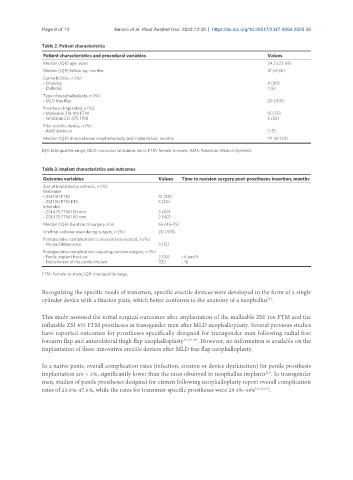
               This study assessed the initial surgical outcomes after implantation of the malleable ZSI 100 FTM and the
               inflatable ZSI 475 FTM prostheses in transgender men after MLD neophalloplasty. Several previous studies
               have reported outcomes for prostheses specifically designed for transgender men following radial free
               forearm flap and anterolateral thigh flap neophalloplasty [14,18-20] . However, no information is available on the
               implantation of these innovative erectile devices after MLD free flap neophalloplasty.

               In a native penis, overall complication rates (infection, erosion or device dysfunction) for penile prosthesis
                                                                                           [21]
               implantation are < 2%, significantly lower than the rates observed in neophallus implants . In transgender
               men, studies of penile prostheses designed for cismen following neophalloplasty report overall complication
               rates of 23.9%-47.6%, while the rates for transmen-specific prostheses were 28.4%-44% [15,22,23] .

