


Page 137 - Read Online
P. 137
Page 10 of 13             Chao et al. Plast Aesthet Res. 2025;12:29  https://dx.doi.org/10.20517/2347-9264.2025.18

               indicator is that a neovagina accommodating a finger to the proximal interphalangeal joint (second
               knuckle) likely has sufficient length for revision using only peritoneal flaps. This can guide preoperative
               counseling and set realistic expectations regarding the need for multiple donor sites.


               Intraoperatively, robotic dissection begins in the rectovesical pouch. Placement of a vaginal dilator or end-
               to-end anastomosis (EEA) sizer in the remnant canal is helpful. The neovaginal cuff is opened, and
               surrounding scar tissue and levator musculature are incised to accommodate the 3.7 cm dilator. In cases of
               severe stenosis, the tubularized skin graft is sutured to the introitus using absorbable sutures in a clock-face
               pattern and inserted into the vaginal space, easily visualized robotically.

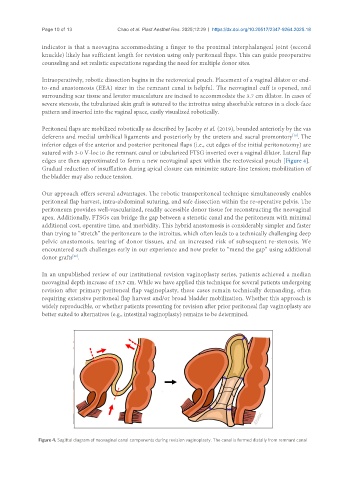
               Peritoneal flaps are mobilized robotically as described by Jacoby et al. (2019), bounded anteriorly by the vas
               deferens and medial umbilical ligaments and posteriorly by the ureters and sacral promontory . The
                                                                                                    [16]
               inferior edges of the anterior and posterior peritoneal flaps (i.e., cut edges of the initial peritonotomy) are
               sutured with 3-0 V-loc to the remnant canal or tubularized FTSG inverted over a vaginal dilator. Lateral flap
               edges are then approximated to form a new neovaginal apex within the rectovesical pouch [Figure 4].
               Gradual reduction of insufflation during apical closure can minimize suture-line tension; mobilization of
               the bladder may also reduce tension.


               Our approach offers several advantages. The robotic transperitoneal technique simultaneously enables
               peritoneal flap harvest, intra-abdominal suturing, and safe dissection within the re-operative pelvis. The
               peritoneum provides well-vascularized, readily accessible donor tissue for reconstructing the neovaginal
               apex. Additionally, FTSGs can bridge the gap between a stenotic canal and the peritoneum with minimal
               additional cost, operative time, and morbidity. This hybrid anastomosis is considerably simpler and faster
               than trying to “stretch” the peritoneum to the introitus, which often leads to a technically challenging deep
               pelvic anastomosis, tearing of donor tissues, and an increased risk of subsequent re-stenosis. We
               encountered such challenges early in our experience and now prefer to “mend the gap” using additional
                         [29]
               donor grafts .

               In an unpublished review of our institutional revision vaginoplasty series, patients achieved a median
               neovaginal depth increase of 13.7 cm. While we have applied this technique for several patients undergoing
               revision after primary peritoneal flap vaginoplasty, these cases remain technically demanding, often
               requiring extensive peritoneal flap harvest and/or broad bladder mobilization. Whether this approach is
               widely reproducible, or whether patients presenting for revision after prior peritoneal flap vaginoplasty are
               better suited to alternatives (e.g., intestinal vaginoplasty) remains to be determined.


              Figure 4. Sagittal diagram of neovaginal canal components during revision vaginoplasty. The canal is formed distally from remnant canal

