


Page 100 - Read Online
P. 100
Page 8 of 11           Sanal et al. Metab Target Organ Damage 2024;4:45  https://dx.doi.org/10.20517/mtod.2024.54

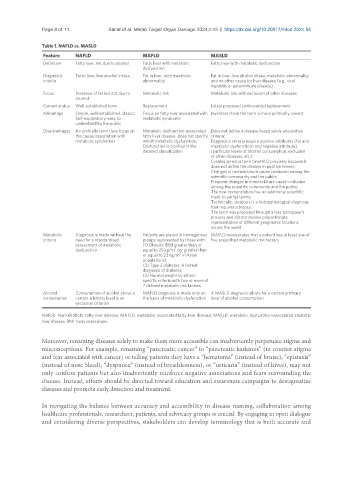
               Table 1. NAFLD vs. MASLD
                Feature   NAFLD                  MAFLD                  MASLD
                Definition  Fatty liver, not due to alcohol  Fatty liver with metabolic   Fatty liver with metabolic dysfunction
                                                 dysfunction
                Diagnostic   Fat in liver, low alcohol intake  Fat in liver, with metabolic   Fat in liver, low alcohol intake, metabolic abnormality
                criteria                         abnormality            and no other cause for liver disease (e.g., viral
                                                                        hepatitis or autoimmune disease)
                Focus     Presence of fat but not due to   Metabolic link  Metabolic link with exclusion of other diseases
                          alcohol
                Current status  Well-established term  Replacement      Latest proposed controversial replacement
                Advantage  Simple, well-established, classic;   Focus on fatty liver associated with  Inventors claim the term is more politically correct
                          Self-explanatory-easy to   metabolic syndrome
                          understand by the public
                Disadvantages  An umbrella term (less focus on   Metabolic dysfunction-associated  Does not define a disease based solely on positive
                          the cause/association with   fatty liver disease- does not specify  criteria;
                          metabolic syndrome)    which metabolic dysfunction;   Diagnostic criteria require positive attributes (fat and
                                                 Dysfunction is clarified in the   metabolic dysfunction) and negative attributes
                                                 detailed classification  (particular levels of alcohol consumption, exclusion
                                                                        of other diseases, etc.);
                                                                        Creates an extra term (metALD precisely because it
                                                                        does not define the disease in positive terms);
                                                                        Changes in nomenclature cause confusion among the
                                                                        scientific community and the public;
                                                                        Frequent changes in nomenclature cause confusion
                                                                        among the scientific community and the public;
                                                                        The new nomenclature has no additional scientific
                                                                        merit to earlier terms;
                                                                        Technically, steatosis is a histopathological diagnosis
                                                                        that requires a biopsy;
                                                                        The term was proposed through a less transparent
                                                                        process and did not involve proportionate
                                                                        representation of different geographic locations
                                                                        across the world
                Metabolic   Diagnosis is made without the   Patients are placed in homogenous  MASLD necessitates that a patient has at least one of
                criteria  need for a standardized   groups represented by those with:  five prescribed metabolic risk factors
                          assessment of metabolic   (1) Obesity: BMI greater than or
                                                            2
                          dysfunction            equal to 25 kg/m  (or greater than
                                                              2
                                                 or equal to 23 kg/m  in Asian
                                                 populations);
                                                 (2) Type 2 diabetes: A formal
                                                 diagnosis of diabetes;
                                                 (3) Normal weight by ethnic-
                                                 specific criteria with two or more of
                                                 7 defined metabolic risk factors
                Alcohol   Consumption of alcohol above a   MAFLD diagnosis is made only on  A MASLD diagnosis allows for a certain arbitrary
                consumption  certain arbitrary level is an   the basis of metabolic dysfunction  level of alcohol consumption
                          exclusion criterion
               NAFLD: Non-alcoholic fatty liver disease; MAFLD: metabolic associated fatty liver disease; MASLD: metabolic dysfunction-associated steatotic
               liver disease; BMI: body mass index.


               Moreover, renaming diseases solely to make them more accessible can inadvertently perpetuate stigma and
               misconceptions. For example, renaming “pancreatic cancer” to “pancreatic karkinos” (to counter stigma
               and fear associated with cancer) or telling patients they have a “hematoma” (instead of bruise), “epistaxis”
               (instead of nose bleed), “dyspnoea” (instead of breathlessness), or “urticaria” (instead of hives), may not
               only confuse patients but also inadvertently reinforce negative associations and fears surrounding the
               disease. Instead, efforts should be directed toward education and awareness campaigns to destigmatize
               diseases and promote early detection and treatment.


               In navigating the balance between accuracy and accessibility in disease naming, collaboration among
               healthcare professionals, researchers, patients, and advocacy groups is crucial. By engaging in open dialogue
               and considering diverse perspectives, stakeholders can develop terminology that is both accurate and

