


Page 49 - Read Online
P. 49
Page 10 of 14                  Cui et al. Microbiome Res Rep. 2025;4:31  https://dx.doi.org/10.20517/mrr.2025.25

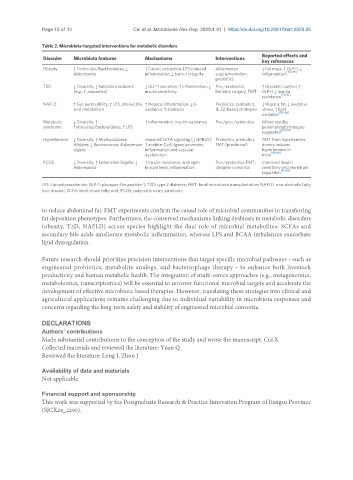
               Table 2. Microbiota-targeted interventions for metabolic disorders
                                                                                         Reported effects and
                Disorder  Microbiota features     Mechanisms              Interventions
                                                                                         key references
                Obesity   ↑ Firmicutes/Bacteroidetes, ↓   ↑ Caloric extraction, LPS-induced   Akkermansia   ↓ Fat mass, ↑ GLP-1, ↓
                          Akkermansia             inflammation, ↓ barrier integrity  supplementation,   inflammation [70-75]
                                                                          prebiotics
                T2D       ↓ Diversity, ↓ butyrate producers   ↓ GLP-1 secretion, ↑ inflammation, ↓  Pro-/prebiotics,   ↑ Glycemic control, ↑
                          (e.g., F. prausnitzii)  insulin sensitivity     bariatric surgery, FMT  GLP-1, ↓ insulin
                                                                                                [76-81]
                                                                                         resistance
                NAFLD     ↑ Gut permeability, ↑ LPS, altered bile  ↑ Hepatic inflammation, ↓ β-  Prebiotics, synbiotics,   ↓ Hepatic fat, ↓ oxidative
                          acid metabolism         oxidation, ↑ steatosis  IL-22-based strategies  stress, ↑ lipid
                                                                                               [82-86]
                                                                                         oxidation
                Metabolic   ↓ Diversity, ↑        ↑ Inflammation, insulin resistance  Pre-/pro-/synbiotics  Mixed results;
                syndrome  Firmicutes/Bacteroidetes, ↑ LPS                                personalized strategies
                                                                                         suggested [87,88]
                Hypertension  ↓ Diversity; ↑ Muribaculaceae,   Impaired SCFA signaling (↓ GPR43);  Probiotics, prebiotics,   FMT from hypertensive
                          Alistipes; ↓ Ruminococcus, Eubacterium  ↑ acetate-CoA ligase; promotes   FMT (preclinical)  donors induces
                          eligens                 inflammation and vascular              hypertension in
                                                  dysfunction                            mice [89,90]
                PCOS      ↓ Diversity, ↑ Escherichia-Shigella, ↓   ↑ Insulin resistance, androgen   Pro-/prebiotics, FMT,   Improved insulin
                          Akkermansia             biosynthesis, inflammation  designer consortia  sensitivity and menstrual
                                                                                         regulation [91-93]
               LPS: Lipopolysaccharide; GLP-1: glucagon-like peptide-1; T2D: type 2 diabetes; FMT: fecal microbiota transplantation; NAFLD: non-alcoholic fatty
               liver disease; SCFA: short-chain fatty acid; PCOS: polycystic ovary syndrome.


               to reduce abdominal fat. FMT experiments confirm the causal role of microbial communities in transferring
               fat deposition phenotypes. Furthermore, the conserved mechanisms linking dysbiosis to metabolic disorders
               (obesity, T2D, NAFLD) across species highlight the dual role of microbial metabolites: SCFAs and
               secondary bile acids ameliorate metabolic inflammation, whereas LPS and BCAA imbalances exacerbate
               lipid dysregulation.


               Future research should prioritize precision interventions that target specific microbial pathways - such as
               engineered probiotics, metabolite analogs, and bacteriophage therapy - to enhance both livestock
               productivity and human metabolic health. The integration of multi-omics approaches (e.g., metagenomics,
               metabolomics, transcriptomics) will be essential to uncover functional microbial targets and accelerate the
               development of effective microbiota-based therapies. However, translating these strategies into clinical and
               agricultural applications remains challenging due to individual variability in microbiota responses and
               concerns regarding the long-term safety and stability of engineered microbial consortia.


               DECLARATIONS
               Authors’ contributions
               Made substantial contributions to the conception of the study and wrote the manuscript: Cui X
               Collected materials and reviewed the literature: Yuan Q
               Reviewed the literature: Long J, Zhou J


               Availability of data and materials
               Not applicable.

               Financial support and sponsorship
               This work was supported by the Postgraduate Research & Practice Innovation Program of Jiangsu Province
               (SJCX24_2293).

