


Page 44 - Read Online
P. 44
Cui et al. Microbiome Res Rep. 2025;4:31  https://dx.doi.org/10.20517/mrr.2025.25  Page 5 of 14

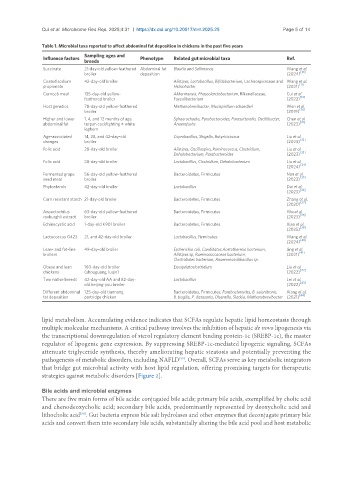
               Table 1. Microbial taxa reported to affect abdominal fat deposition in chickens in the past five years
                             Sampling ages and
                Influence factors               Phenotype   Related gut microbial taxa            Ref.
                             breeds
                Succinate    21-day-old yellow-feathered  Abdominal fat   Blautia and Sellimonas  Wang et al.
                             broiler            deposition                                        (2024) [10]
                Coated sodium   42-day-old broiler          Alistipes, Lactobacillus, Bifidobacterium, Lachnospiraceae and  Wang et al.
                propionate                                  Helicobacter                          (2021) [11]
                Corncob meal  135-day-old yellow-           Akkermansia, Phascolarctobacterium, Rikenellaceae,   Cui et al.
                                                                                                      [12]
                             feathered broiler              Faecalibacterium                      (2022)
                Host genetics  78-day-old yellow-feathered   Methanobrevibacter, Mucispirillum schaedleri  Wen et al.
                             broiler                                                              (2019) [30]
                Higher and lower   1, 4, and 12 months of age   Sphaerochaeta, Parabacteroides, Parasutterella, Oscillibacter,   Chen et al.
                                                                                                      [31]
                abdominal fat  turpan cockfighting × white   Anaerofustis                         (2023)
                             leghorn
                Age-associated   14, 28, and 42-day-old     Coprobacillus, Shigella, Butyricicoccus  Liu et al.
                changes      broiler                                                              (2023) [32]
                Folic acid   28-day-old broiler             Alistipes, Oscillospira, Ruminococcus, Clostridium,   Liu et al.
                                                                                                      [33]
                                                            Dehalobacterium, Parabacteroides      (2023)
                Folic acid   28-day-old broiler             Lactobacillus, Clostridium, Dehalobacterium  Liu et al.
                                                                                                      [34]
                                                                                                  (2024)
                Fermented grape   56-day-old yellow-feathered   Bacteroidetes, Firmicutes         Nan et al.
                                                                                                      [35]
                seed meal    broiler                                                              (2022)
                Phytosterols  42-day-old broiler            Lactobacillus                         Dai et al.
                                                                                                      [36]
                                                                                                  (2023)
                Corn resistant starch 21-day-old broiler    Bacteroidetes, Firmicutes             Zhang et al.
                                                                                                      [37]
                                                                                                  (2020)
                Anoectochilus   63-day-old yellow-feathered   Bacteroidetes, Firmicutes           Wu et al.
                                                                                                      [38]
                roxburghii extract  broiler                                                       (2023)
                Echinocystic acid  1-day-old K901 broiler   Bacteroidetes, Firmicutes             Xiao et al.
                                                                                                      [39]
                                                                                                  (2025)
                Lactococcus G423  21, and 42-day-old broiler  Lactobacillus, Firmicutes           Wang et al.
                                                                                                  (2024) [40]
                Lean- and fat-line   49-day-old broiler     Escherichia coli, Candidatus Acetothermia bacterium,   Jing et al.
                broilers                                    Alistipes sp, Ruminococcaceae bacterium,   (2021) [41]
                                                            Clostridiales bacterium, Anaeromassilibacillus sp.
                Obese and lean   160-day-old broiler        Erysipelatoclostridium                Liu et al.
                                                                                                      [42]
                chickens     (shouguang, luqin)                                                   (2022)
                Two native breeds  42-day-old AA and 82-day-  Lactobacillus                       Lei et al.
                                                                                                      [43]
                             old beijing-you broiler                                              (2022)
                Different abdominal  125-day-old tiannong   Bacteroidetes, Firmicutes, Parabacteroides, B. salanitronis,   Xiang et al.
                                                                                                      [44]
                fat deposition  partridge chicken           B. fragilis, P. distasonis, Olsenella, Slackia, Methanobrevibacter (2021)
               lipid metabolism. Accumulating evidence indicates that SCFAs regulate hepatic lipid homeostasis through
               multiple molecular mechanisms. A critical pathway involves the inhibition of hepatic de novo lipogenesis via
               the transcriptional downregulation of sterol regulatory element binding protein-1c (SREBP-1c), the master
               regulator of lipogenic gene expression. By suppressing SREBP-1c-mediated lipogenic signaling, SCFAs
               attenuate triglyceride synthesis, thereby ameliorating hepatic steatosis and potentially preventing the
               pathogenesis of metabolic disorders, including NAFLD . Overall, SCFAs serve as key metabolic integrators
                                                             [49]
               that bridge gut microbial activity with host lipid regulation, offering promising targets for therapeutic
               strategies against metabolic disorders [Figure 2].


               Bile acids and microbial enzymes
               There are five main forms of bile acids: conjugated bile acids; primary bile acids, exemplified by cholic acid
               and chenodeoxycholic acid; secondary bile acids, predominantly represented by deoxycholic acid and
                            [50]
               lithocholic acid . Gut bacteria express bile salt hydrolases and other enzymes that deconjugate primary bile
               acids and convert them into secondary bile acids, substantially altering the bile acid pool and host metabolic

