Page 54 - Read Online
P. 54

Page 8 of 13                                                                             Pennestrì et al. Mini-invasive Surg. 2025;9:16  https://dx.doi.org/10.20517/2574-1225.2025.03


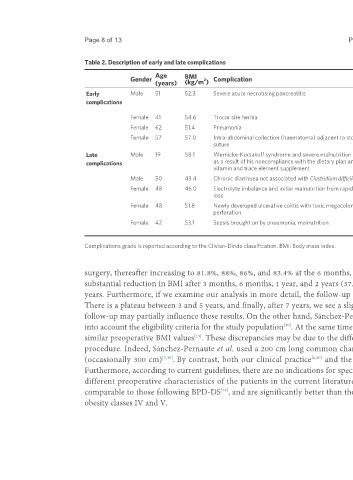
                              Table 2. Description of early and late complications

                                                     Age       BMI
                                             Gender                   2  Complication                                              Grade Treatment
                                                     (years)   (kg/m )
                              Early          Male    51        52.3      Severe acute necrotising pancreatitis                     IV     Debridement and necrosectomy, anastomotic breakdown, gastrostomy and
                              complications                                                                                               jejunostomy for feeding, open abdomen technique and vacuum-assisted therapy;
                                                                                                                                          conversion to one anastomosis gastric bypass 4 months later
                                             Female  41        54.6      Trocar site hernia                                        IIIb   Surgical revision: reduction of the herniated intestinal loop and defect closure
                                             Female  62        51.4      Pneumonia                                                 II     Intravenous antimicrobial therapy
                                             Female  57        57.0      Intra-abdominal collection (haematoma) adjacent to stomach   II  Intravenous antimicrobial therapy
                                                                         suture
                              Late           Male    19        58.1      Wernicke-Korsakoff syndrome and severe malnutrition developed  IIIb  Conversion to Roux-en-Y gastric bypass
                              complications                              as a result of his noncompliance with the dietary plan and the
                                                                         vitamin and trace element supplement
                                             Male    50        43.4      Chronic diarrhoea not associated with Clostridium difficile  II  Oral antibiotic therapy and supplementation with pre/probiotics
                                             Female  48        46.0      Electrolyte imbalance and initial malnutrition from rapid weight   II  Intravenous supplementation
                                                                         loss
                                             Female  48        51.8      Newly developed ulcerative colitis with toxic megacolon and bowel  IV  Urgent total colectomy and end ileostomy
                                                                         perforation
                                             Female  42        53.1      Sepsis brought on by pneumonia, malnutrition              V      Intravenous antimicrobial therapy, refusal to accept supplements and nutritional
                                                                                                                                          guidance, uncontactable during follow-up

                              Complications grade is reported according to the Clivien-Dindo classification. BMI: Body mass index.


                              surgery, thereafter increasing to 81.8%, 88%, 86%, and 83.4% at the 6 months, 1 year, 2 years, 3 years, and 5 years follow-ups, respectively. Nevertheless, the
                              substantial reduction in BMI after 3 months, 6 months, 1 year, and 2 years (37.4, 33.7, 29.9, and 29.3 kg/m , respectively) exhibited a slight increase at 3 and 5
                                                                                                                                                        2
                              years. Furthermore, if we examine our analysis in more detail, the follow-up data [Table 3] show a nadir of bariatric results two years after the procedure.
                              There is a plateau between 3 and 5 years, and finally, after 7 years, we see a slight weight gain. However, the number of patients eligible for different years of
                              follow-up may partially influence these results. On the other hand, Sánchez-Pernaute et al. reported a similar trend, but the data should be interpreted taking

                              into account the eligibility criteria for the study population . At the same time, Surve et al. reported data consistent with ours, focusing on patients with more
                                                                                                 [30]
                              similar preoperative BMI values . These discrepancies may be due to the different lengths of the common limb and the specific surgical indications for this
                                                                  [13]
                              procedure. Indeed, Sánchez-Pernaute et al. used a 200 cm long common channel at the beginning of their experience, which was later adjusted to 250 cm
                              (occasionally 300 cm)     [7,30] . By contrast, both our clinical practice  [6,20]  and the experience of Surve et al.   [13,34]  consistently employ a 300 cm common limb.

                              Furthermore, according to current guidelines, there are no indications for specific bariatric procedures in different obesity classes , as can be observed in the
                                                                                                                                                                                  [35]
                              different preoperative characteristics of the patients in the current literature. Nonetheless, to summarize, clinical outcomes associated with SADI-S are
                                                                           [14]
                              comparable to those following BPD-DS , and are significantly better than those of other surgeries such as gastric bypasses                     [36,37] , particularly in patients with
                              obesity classes IV and V.
   49   50   51   52   53   54   55   56   57   58   59