


Page 27 - Read Online
P. 27
Page 6 of 9  Murillo et al. Mini-invasive Surg. 2025;9:7  https://dx.doi.org/10.20517/2574-1225.2024.55


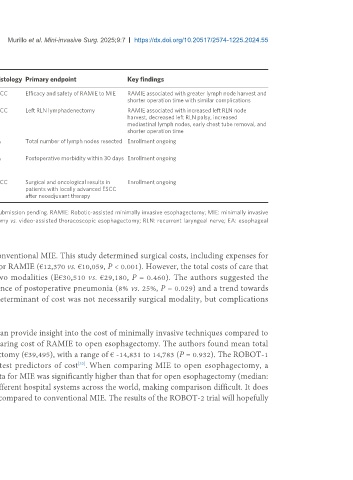
 Table 1. Completed and ongoing randomized controlled trials for RAMIE

 Study   Year  Number of   Location  Surgical procedures  Histology Primary endpoint  Key findings
 name  patients
 RAMIE   2022  358  China  RAMIE   ESCC  Efficacy and safety of RAMIE to MIE  RAMIE associated with greater lymph node harvest and
 trial  Conventional total MIE              shorter operation time with similar complications
 REVATE  2022  212  China and   RAMIE   ESCC  Left RLN lymphadenectomy  RAMIE associated with increased left RLN node
 1
 trial  Taiwan  Conventional total MIE      harvest, decreased left RLN palsy, increased
                                            mediastinal lymph nodes, early chest tube removal, and
                                            shorter operation time
 ROBOT-2  Ongoing Enrolling  Europe  RAMIE   EA  Total number of lymph nodes resected Enrollment ongoing
 trial  Conventional total MIE
 MICkey   Ongoing Enrolling  Germany and   Hybrid esophagectomy (laparoscopic/robotic   EA  Postoperative morbidity within 30 days Enrollment ongoing
 trial  the Netherlands abdominal and open thoracic surgery) to total
 MIE (robotic/laparoscopic)
 RAMIE-2 Ongoing Enrolling  China  RAMIE   ESCC  Surgical and oncological results in   Enrollment ongoing
 Conventional total MIE  patients with locally advanced ESCC
          after neoadjuvant therapy

 1
 REVATE trial preliminary results with abstract presented at UGIRA Conference 2024 with manuscript submission pending. RAMIE: Robotic-assisted minimally invasive esophagectomy; MIE: minimally invasive
 esophagectomy; ESCC: esophageal squamous cell carcinoma; REVATE: robotic-assisted esophagectomy vs. video-assisted thoracoscopic esophagectomy; RLN: recurrent laryngeal nerve; EA: esophageal
 adenocarcinoma.


 one single institution study from Germany comparing costs in RAMIE and conventional MIE. This study determined surgical costs, including expenses for
 disposable instruments and sterilization of reusable instruments, were higher for RAMIE (€12,370 vs. €10,059, P < 0.001). However, the total costs of care that
 includes the postoperative hospitalization were comparable between the two modalities (E€30,510 vs. €29,180, P = 0.460). The authors suggested the

 equalization of cost could be attributed to RAMIE resulting in a lower incidence of postoperative pneumonia (8% vs. 25%, P = 0.029) and a trend towards
 [32]
 shorter hospital stays (15 vs. 17 days, P = 0.205) . Therefore, the greatest determinant of cost was not necessarily surgical modality, but complications
 resulting in longer hospital stays.


 Though not directly comparing conventional MIE to RAMIE, previous trials can provide insight into the cost of minimally invasive techniques compared to
 open esophagectomy. The ROBOT-1 trial published a follow-up study comparing cost of RAMIE to open esophagectomy. The authors found mean total

 hospital costs were comparable between RAMIE (€40,211) and open esophagectomy (€39,495), with a range of € -14,831 to 14,783 (P = 0.932). The ROBOT-1
 group similarly concluded that postoperative complications were the greatest predictors of cost . When comparing MIE to open esophagectomy, a
                           [33]
 randomized control trial with 5,000 cases found overall treatment cost per capita for MIE was significantly higher than that for open esophagectomy (median:
 $9,600 vs. $8,200, P < 0.001) . Notably, these studies were all completed in different hospital systems across the world, making comparison difficult. It does
 [34]
 not appear at this time that RAMIE has significantly different total cost of care compared to conventional MIE. The results of the ROBOT-2 trial will hopefully

