


Page 30 - Read Online
P. 30
Page 345                    Gonzalez Castillo et al. J Transl Genet Genom. 2025;9:338-51  https://dx.doi.org/10.20517/jtgg.2025.57

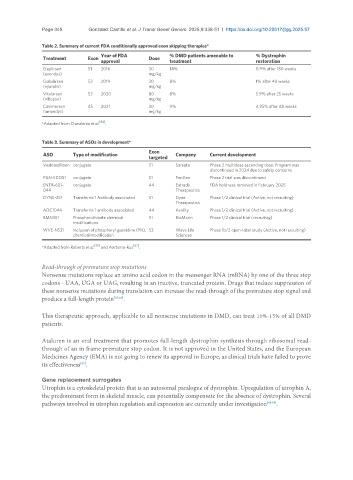
               Table 2. Summary of current FDA conditionally approved exon skipping therapies*
                                   Year of FDA            % DMD patients amenable to   % Dystrophin
                Treatment      Exon                Dose
                                   approval               treatment                    restoration
                Eteplirsen     51  2016            30     14%                          0.9% after 180 weeks
                (exondys)                          mg/kg
                Golodirsen     53  2019            30     8%                           1% after 48 weeks
                (vyondis)                          mg/kg
                Vitolarsen     53  2020            80     8%                           5.9% after 25 weeks
                (viltepso)                         mg/kg
                Casimersen     45  2021            30     9%                           4.25% after 48 weeks
                (amondys)                          mg/kg
                                   [64]
               *Adapted from Chwalenia et al.  .

               Table 3. Summary of ASOs in development*
                                                   Exon
                ASO       Type of modification              Company     Current development
                                                   targeted
                Vesleteplirsen conjugate           51       Sarepta     Phase 2 multidose ascending dose. Program was
                                                                        discontinued in 2024 due to safety concerns
                PGN-EDO51  conjugate               51       PepGen      Phase 2 trial was discontinued
                ENTR-601-  conjugate               44       Entrada     FDA hold was removed in February 2025
                044                                         Therapeutics
                DYNE-251  Transferrin 1 Antibody associated  51  Dyne   Phase 1/2 clinical trial (Active, not recruiting)
                                                            Therapeutics
                AOC1044   Transferrin 1 antibody associated  44  Avidity  Phase 1/2 clinical trial (Active, not recruiting)
                BMN351    Phosphorothioate chemical   51    BioMarin    Phase 1/2 clinical trial (recruiting)
                          modifications
                WVE-N531  Inclusion of phosphoryl guanidine (PN),  53  Wave Life   Phase 1b/2 open-label study (Active, not recruiting)
                          chemical modification             Sciences

               *Adapted from Roberts et al. [36]  and Aartsma-Rus [62] .

               Read-through of premature stop mutations
               Nonsense mutations replace an amino acid codon in the messenger RNA (mRNA) by one of the three stop
               codons - UAA, UGA or UAG, resulting in an inactive, truncated protein. Drugs that induce suppression of
               these nonsense mutations during translation can increase the read-through of the premature stop signal and
               produce a full-length protein [65,66] .


               This therapeutic approach, applicable to all nonsense mutations in DMD, can treat 10%-15% of all DMD
               patients.


               Ataluren is an oral treatment that promotes full-length dystrophin synthesis through ribosomal read-
               through of an in frame premature stop codon. It is not approved in the United States, and the European
               Medicines Agency (EMA) is not going to renew its approval in Europe, as clinical trials have failed to prove
               its effectiveness .
                            [67]
               Gene replacement surrogates
               Utrophin is a cytoskeletal protein that is an autosomal paralogue of dystrophin. Upregulation of utrophin A,
               the predominant form in skeletal muscle, can potentially compensate for the absence of dystrophin. Several
               pathways involved in utrophin regulation and expression are currently under investigation [68,69] .

