


Page 119 - Read Online
P. 119
Li et al. J. Mater. Inf. 2026, 6, 10                                             Page 11 of 31


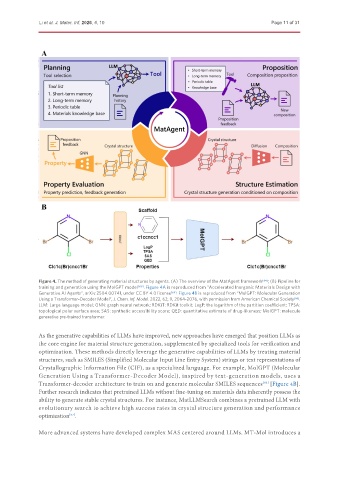
               Figure 4. The method of generating material structures by agents. (A) The overview of the MatAgent framework [64] ; (B) Pipeline for
               training and generation using the MolGPT model  [66] . Figure 4A is reproduced from “Accelerated Inorganic Materials Design with
               Generative AI Agents”, arXiv:2504.00741, under CC BY 4.0 license  [64] . Figure 4B is reproduced from “MolGPT: Molecular Generation
               Using a Transformer-Decoder Model”, J. Chem. Inf. Model. 2022, 62, 9, 2064-2076, with permission from American Chemical Society [66] .
               LLM: Large language model; GNN: graph neural network; RDKiT: RDKit toolkit; LogP: the logarithm of the partition coefficient; TPSA:
               topological polar surface area; SAS: synthetic accessibility score; QED: quantitative estimate of drug-likeness; MolGPT: molecule
               generative pre-trained transformer.

               As the generative capabilities of LLMs have improved, new approaches have emerged that position LLMs as
               the core engine for material structure generation, supplemented by specialized tools for verification and
               optimization. These methods directly leverage the generative capabilities of LLMs by treating material
               structures, such as SMILES (Simplified Molecular Input Line Entry System) strings or text representations of
               Crystallographic Information File (CIF), as a specialized language. For example, MolGPT (Molecular
               Generation Using a Transformer-Decoder Model), inspired by text-generation models, uses a
               Transformer-decoder architecture to train on and generate molecular SMILES sequences  [Figure 4B].
                                                                                             [66]
               Further research indicates that pretrained LLMs without fine-tuning on materials data inherently possess the
               ability to generate stable crystal structures. For instance, MatLLMSearch combines a pretrained LLM with
               evolutionary search to achieve high success rates in crystal structure generation and performance
               optimization .
                         [67]

               More advanced systems have developed complex MAS centered around LLMs. MT-Mol introduces a

