


Page 115 - Read Online
P. 115
Li et al. J. Mater. Inf. 2026, 6, 10                                              Page 7 of 31


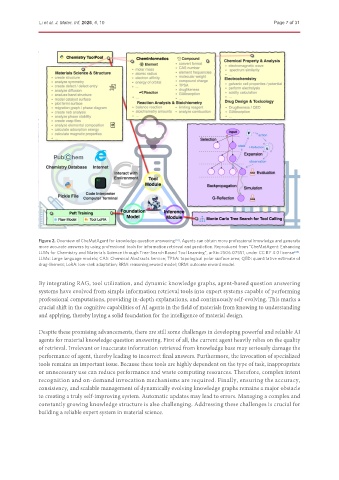
               Figure 2. Overview of CheMatAgent for knowledge question answering [33] . Agents can obtain more professional knowledge and generate
               more accurate answers by using professional tools for information retrieval and prediction. Reproduced from “CheMatAgent: Enhancing
               LLMs for Chemistry and Materials Science through Tree-Search Based Tool Learning”, arXiv:2506.07551, under CC BY 4.0 license  [33] .
               LLMs: Large language models; CAS: Chemical Abstracts Service; TPSA: topological polar surface area; QED: quantitative estimate of
               drug-likeness; LoRA: low-rank adaptation; RRM: reasoning reward model; ORM: outcome reward model.


               By integrating RAG, tool utilization, and dynamic knowledge graphs, agent-based question answering
               systems have evolved from simple information retrieval tools into expert systems capable of performing
               professional computations, providing in-depth explanations, and continuously self-evolving. This marks a
               crucial shift in the cognitive capabilities of AI agents in the field of materials from knowing to understanding
               and applying, thereby laying a solid foundation for the intelligence of material design.


               Despite these promising advancements, there are still some challenges in developing powerful and reliable AI
               agents for material knowledge question answering. First of all, the current agent heavily relies on the quality
               of retrieval. Irrelevant or inaccurate information retrieved from knowledge base may seriously damage the
               performance of agent, thereby leading to incorrect final answers. Furthermore, the invocation of specialized
               tools remains an important issue. Because these tools are highly dependent on the type of task, inappropriate
               or unnecessary use can reduce performance and waste computing resources. Therefore, complex intent
               recognition and on-demand invocation mechanisms are required. Finally, ensuring the accuracy,
               consistency, and scalable management of dynamically evolving knowledge graphs remains a major obstacle
               to creating a truly self-improving system. Automatic updates may lead to errors. Managing a complex and
               constantly growing knowledge structure is also challenging. Addressing these challenges is crucial for
               building a reliable expert system in material science.

