


Page 117 - Read Online
P. 117
Li et al. J. Mater. Inf. 2026, 6, 10                                              Page 9 of 31


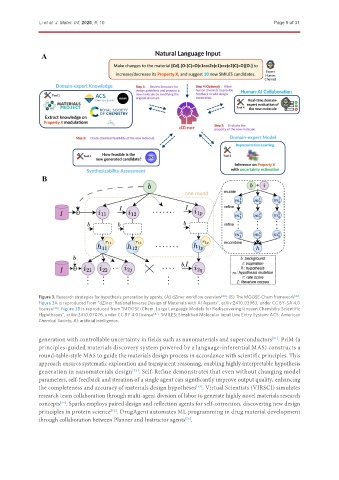
               Figure 3. Research strategies for hypothesis generation by agents. (A) dZiner workflow overview [40] ; (B) The MOOSE-Chem framework [47] .
               Figure 3A is reproduced from “dZiner: Rational Inverse Design of Materials with AI Agents”, arXiv:2410.03963, under CC BY-SA 4.0
               license [40] . Figure 3B is reproduced from “MOOSE-Chem: Large Language Models for Rediscovering Unseen Chemistry Scientific
               Hypotheses”, arXiv:2410.07076, under CC BY 4.0 license [47] . SMILES: Simplified Molecular Input Line Entry System; ACS: American
               Chemical Society; AI: artificial intelligence.

               generation with controllable uncertainty in fields such as nanomaterials and superconductors . PriM (a
                                                                                                 [51]
               principles-guided materials discovery system powered by a language-inferential MAS) constructs a
               round-table-style MAS to guide the materials design process in accordance with scientific principles. This
               approach ensures systematic exploration and transparent reasoning, enabling highly interpretable hypothesis
               generation in nanomaterials design . Self-Refine demonstrates that even without changing model
                                               [52]
               parameters, self-feedback and iteration of a single agent can significantly improve output quality, enhancing
               the completeness and accuracy of materials design hypotheses . Virtual Scientists (VIRSCI) simulates
                                                                      [53]
               research team collaboration through multi-agent division of labor to generate highly novel materials research
               concepts . Sparks employs paired design and reflection agents for self-correction, discovering new design
                      [54]
               principles in protein science . DrugAgent automates ML programming in drug material development
                                        [55]
               through collaboration between Planner and Instructor agents .
                                                                  [56]

