


Page 67 - Read Online
P. 67
Page 4 of 15                         Wu et al. J. Mater. Inf. 2025, 5, 14  https://dx.doi.org/10.20517/jmi.2024.77


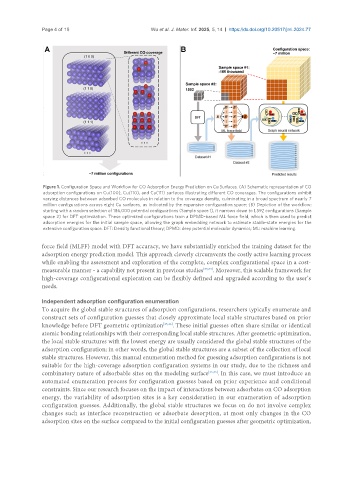
                Figure 1. Configuration Space and Workflow for CO Adsorption Energy Prediction on Cu Surfaces. (A) Schematic representation of CO
                adsorption configurations on Cu(100), Cu(110), and Cu(111) surfaces illustrating different CO coverages. The configurations exhibit
                varying distances between adsorbed CO molecules in relation to the coverage density, culminating in a broad spectrum of nearly 7
                million configurations across eight Cu surfaces, as indicated by the expansive configuration space; (B) Depiction of the workflow:
                starting with a random selection of 186,000 potential configurations (Sample space 1), it narrows down to 1,592 configurations (Sample
                space 2) for DFT optimization. These optimized configurations train a DPMD-based ML force field, which is then used to predict
                adsorption energies for the initial sample space, allowing the graph embedding network to estimate stable-state energies for the
                extensive configuration space. DFT: Density functional theory; DPMD: deep potential molecular dynamics; ML: machine learning.

               force field (MLFF) model with DFT accuracy, we have substantially enriched the training dataset for the
               adsorption energy prediction model. This approach cleverly circumvents the costly active learning process
               while enabling the assessment and exploration of the complete, complex configurational space in a cost-
               measurable manner - a capability not present in previous studies [33,34] . Moreover, this scalable framework for
               high-coverage configurational exploration can be flexibly defined and upgraded according to the user’s
               needs.


               Independent adsorption configuration enumeration
               To acquire the global stable structures of adsorption configurations, researchers typically enumerate and
               construct sets of configuration guesses that closely approximate local stable structures based on prior
               knowledge before DFT geometric optimization [35,36] . These initial guesses often share similar or identical
               atomic bonding relationships with their corresponding local stable structures. After geometric optimization,
               the local stable structures with the lowest energy are usually considered the global stable structures of the
               adsorption configuration; in other words, the global stable structures are a subset of the collection of local
               stable structures. However, this manual enumeration method for guessing adsorption configurations is not
               suitable for the high-coverage adsorption configuration systems in our study, due to the richness and
               combinatory nature of adsorbable sites on the modeling surface [25,35] . In this case, we must introduce an
               automated enumeration process for configuration guesses based on prior experience and conditional
               constraints. Since our research focuses on the impact of interactions between adsorbates on CO adsorption
               energy, the variability of adsorption sites is a key consideration in our enumeration of adsorption
               configuration guesses. Additionally, the global stable structures we focus on do not involve complex
               changes such as interface reconstruction or adsorbate desorption, at most only changes in the CO
               adsorption sites on the surface compared to the initial configuration guesses after geometric optimization,

