


Page 77 - Read Online
P. 77
Page 18 of 25                       Meng et al. J. Mater. Inf. 2025, 5, 3  https://dx.doi.org/10.20517/jmi.2024.74


                                                                                 *
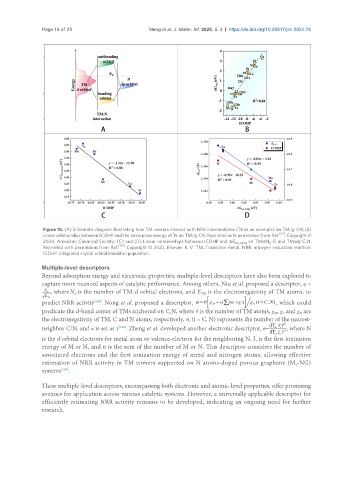
                Figure 10. (A) Schematic diagram illustrating how TM centers interact with NRR intermediates ( N as an example) on TM/g-CN; (B)
                                                           *
                Linear relationship between ICOHP and the adsorption energy of  N on TM/g-CN. Reprinted with permission from Ref. [42] . Copyright ©
                2020, American Chemical Society; (C) and (D) Linear relationships between ICOHP and ΔG N2-NNH  on TM@N -G and TM@g-C N.
                                                                                                        2
                                                                                            6
                Reprinted with permission from  Ref. [125] . Copyright © 2022, Elsevier B. V. TM: Transition metal; NRR: nitrogen reduction reaction;
                ICOHP: integrated crystal orbital Hamilton population.
               Multiple-level descriptors
               Beyond adsorption energy and electronic properties, multiple-level descriptors have also been explored to
               capture more nuanced aspects of catalytic performance. Among others, Niu et al. proposed a descriptor, φ =
                  , where N  is the number of TM-d orbital electrons, and E  is the electronegativity of TM atoms, to
                TTM       d                                          TM
                                 [128]
               predict NRR activity . Nong et al. proposed a descriptor, φ = θ+ α∑(ni + χi)]/χn(i = C, N), which could
               predicate the d-band center of TMs anchored on C N, where θ is the number of TM atoms, χ , χ  and χ  are
                                                                                                      N
                                                          3
                                                                                                C
                                                                                             M
               the electronegativity of TM, C and N atoms, respectively, n (i = C, N) represents the number of the nearest-
                                                                 i
               neighbor C/N, and α is set as 1 . Zheng et al. developed another electronic descriptor, φ =  N), where N
                                                                                             n
                                         [128]
                                                                                              i=1
                                                                                                 i
               is the d orbital electrons for metal atom or valence-electron for the neighboring N, I  is the first ionization
                                                                                       1
               energy of M or N, and n is the sum of the number of M or N. This descriptor considers the number of
               associated electrons and the first ionization energy of metal and nitrogen atoms, allowing effective
               estimation of NRR activity in TM trimers supported on N atoms-doped porous graphene (M -NG)
                                                                                                     3
               systems .
                      [129]
               These multiple-level descriptors, encompassing both electronic and atomic-level properties, offer promising
               avenues for application across various catalytic systems. However, a universally applicable descriptor for
               efficiently estimating NRR activity remains to be developed, indicating an ongoing need for further
               research.

