


Page 114 - Read Online
P. 114
Author Instructions

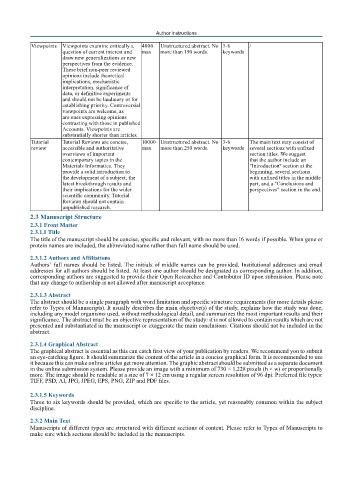
            Viewpoints  Viewpoints examine critically a   4000   Unstructured abstract. No  3-6   /
                      question of current interest and   max  more than 150 words.  keywords
                      draw new generalizations or new
                      perspectives from the evidence.
                      These brief non-peer reviewed
                      opinions include theoretical
                      implications, mechanistic
                      interpretation, significance of
                      data, or definitive experiments
                      and should not be laudatory or for
                      establishing priority. Controversial
                      viewpoints are welcome, as
                      are ones expressing opinions
                      contrasting with those in published
                      Accounts. Viewpoints are
                      substantially shorter than articles.
            Tutorial   Tutorial Reviews are concise,   10000  Unstructured abstract. No  3-6   The main text may consist of
            review    accessible and authoritative   max  more than 250 words.  keywords  several sections with unfixed
                      overviews of important                                         section titles. We suggest
                      contemporary topics in the                                     that the author include an
                      Materials Informatics. They                                    "Introduction" section at the
                      provide a solid introduction to                                beginning, several sections
                      the development of a subject, the                              with unfixed titles in the middle
                      latest breakthrough results and                                part, and a "Conclusions and
                      their implications for the wider                               perspectives" section in the end.
                      scientific community. Tutorial
                      Reviews should not contain
                      unpublished research.
           2.3 Manuscript Structure
           2.3.1 Front Matter
           2.3.1.1 Title
           The title of the manuscript should be concise, specific and relevant, with no more than 16 words if possible. When gene or
           protein names are included, the abbreviated name rather than full name should be used.
           2.3.1.2 Authors and Affiliations
           Authors’ full names should be listed. The initials of middle names can be provided. Institutional addresses and email
           addresses for all authors should be listed. At least one author should be designated as corresponding author. In addition,
           corresponding authors are suggested to provide their Open Researcher and Contributor ID upon submission. Please note
           that any change to authorship is not allowed after manuscript acceptance.

           2.3.1.3 Abstract
           The abstract should be a single paragraph with word limitation and specific structure requirements (for more details please
           refer to Types of Manuscripts). It usually describes the main objective(s) of the study, explains how the study was done,
           including any model organisms used, without methodological detail, and summarizes the most important results and their
           significance. The abstract must be an objective representation of the study: it is not allowed to contain results which are not
           presented and substantiated in the manuscript or exaggerate the main conclusions. Citations should not be included in the
           abstract.

           2.3.1.4 Graphical Abstract
           The graphical abstract is essential as this can catch first view of your publication by readers. We recommend you to submit
           an eye-catching figure. It should summarize the content of the article in a concise graphical form. It is recommended to use
           it because this can make online articles get more attention. The graphic abstract should be submitted as a separate document
           in the online submission system. Please provide an image with a minimum of 730 × 1,228 pixels (h × w) or proportionally
           more. The image should be readable at a size of 7 × 12 cm using a regular screen resolution of 96 dpi. Preferred file types:
           TIFF, PSD, AI, JPG, JPEG, EPS, PNG, ZIP and PDF files.

           2.3.1.5 Keywords
           Three to six keywords should be provided, which are specific to the article, yet reasonably common within the subject
           discipline.

           2.3.2 Main Text
           Manuscripts of different types are structured with different sections of content. Please refer to Types of Manuscripts to
           make sure which sections should be included in the manuscripts.

