


Page 68 - Read Online
P. 68
Page 289                       Zhuang et al. Intell Robot 2024;4(3):276-92  I http://dx.doi.org/10.20517/ir.2024.18


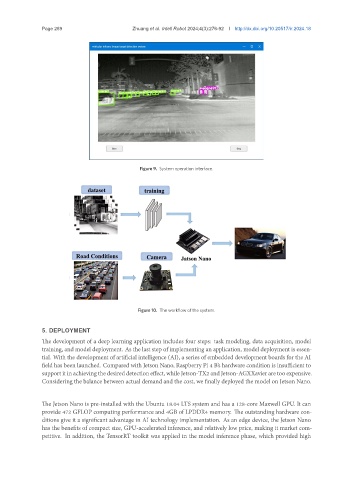
                                                Figure 9. System operation interface.


                                                Figure 10. The workflow of the system.


               5. DEPLOYMENT
               The development of a deep learning application includes four steps: task modeling, data acquisition, model
               training, and model deployment. As the last step of implementing an application, model deployment is essen-
               tial. With the development of artificial intelligence (AI), a series of embedded development boards for the AI
               field has been launched. Compared with Jetson Nano, Raspberry Pi 4 B’s hardware condition is insufficient to
               support it in achieving the desired detection effect, while Jetson-TX2 and Jetson-AGXXavier are too expensive.
               Considering the balance between actual demand and the cost, we finally deployed the model on Jetson Nano.


               The Jetson Nano is pre-installed with the Ubuntu 18.04 LTS system and has a 128-core Maxwell GPU. It can
               provide 472 GFLOP computing performance and 4GB of LPDDR4 memory. The outstanding hardware con-
               ditions give it a significant advantage in AI technology implementation. As an edge device, the Jetson Nano
               has the benefits of compact size, GPU-accelerated inference, and relatively low price, making it market com-
               petitive. In addition, the TensorRT toolkit was applied in the model inference phase, which provided high

