


Page 59 - Read Online
P. 59
Zhuang et al. Intell Robot 2024;4(3):276-92  I http://dx.doi.org/10.20517/ir.2024.18  Page 280


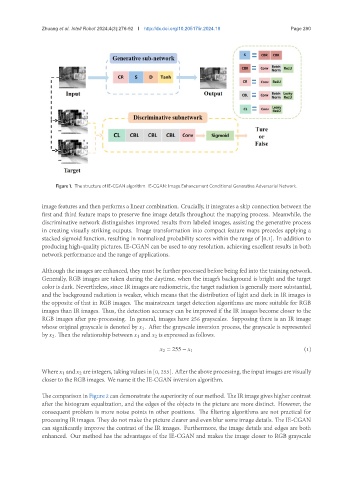
                    Figure 1. The structure of IE-CGAN algorithm. IE-CGAN: Image Enhancement Conditional Generative Adversarial Network.


               image features and then performs a linear combination. Crucially, it integrates a skip connection between the
               first and third feature maps to preserve fine image details throughout the mapping process. Meanwhile, the
               discriminative network distinguishes improved results from labeled images, assisting the generative process
               in creating visually striking outputs. Image transformation into compact feature maps precedes applying a
               stacked sigmoid function, resulting in normalized probability scores within the range of [0,1]. In addition to
               producing high-quality pictures, IE-CGAN can be used to any resolution, achieving excellent results in both
               network performance and the range of applications.

               Although the images are enhanced, they must be further processed before being fed into the training network.
               Generally, RGB images are taken during the daytime, when the image’s background is bright and the target
               color is dark. Nevertheless, since IR images are radiometric, the target radiation is generally more substantial,
               and the background radiation is weaker, which means that the distribution of light and dark in IR images is
               the opposite of that in RGB images. The mainstream target detection algorithms are more suitable for RGB
               images than IR images. Thus, the detection accuracy can be improved if the IR images become closer to the
               RGB images after pre-processing. In general, images have 256 grayscales. Supposing there is an IR image
               whose original grayscale is denoted by    1. After the grayscale inversion process, the grayscale is represented
               by    2. Then the relationship between    1 and    2 is expressed as follows.

                                                                                                        (1)
                                                          2 = 255 −    1

               Where    1 and    2 are integers, taking values in [0, 255]. After the above processing, the input images are visually
               closer to the RGB images. We name it the IE-CGAN inversion algorithm.

               ThecomparisoninFigure2candemonstratethesuperiorityofourmethod. TheIRimagegiveshighercontrast
               after the histogram equalization, and the edges of the objects in the picture are more distinct. However, the
               consequent problem is more noise points in other positions. The filtering algorithms are not practical for
               processing IR images. They do not make the picture clearer and even blur some image details. The IE-CGAN
               can significantly improve the contrast of the IR images. Furthermore, the image details and edges are both
               enhanced. Our method has the advantages of the IE-CGAN and makes the image closer to RGB grayscale

