


Page 40 - Read Online
P. 40
Liu et al. Intell Robot 2024;4(4):503-23  I http://dx.doi.org/10.20517/ir.2024.29   Page 509

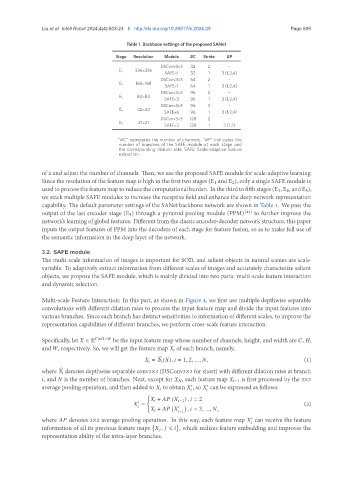
                                            Table 1. Backbone settings of the proposed SANet

                                        Stage  Resolution  Module  #C  Stride  #P
                                                       DSConv3×3  32   2      -
                                               336×336
                                         E 1
                                                         SAFE×1  32    1    3 (1,2,4)
                                                       DSConv3×3  64   2      -
                                               168×168
                                         E 2
                                                         SAFE×1  64    1    3 (1,2,4)
                                                       DSConv3×3  96   2      -
                                               84×84
                                         E 3
                                                        SAFE×3   96    1    3 (1,2,4)
                                                       DSConv3×3  96   2      -
                                               42×42
                                         E 4
                                                        SAFE×6   96    1    3 (1,2,4)
                                                       DSConv3×3  128  2      -
                                                21×21
                                         E 5
                                                        SAFE×3   128   1    2 (1,2)
                                         “#C” represents the number of channels. “#P” indi-cates the
                                         number of branches of the SAFE module at each stage and
                                         the corresponding dilation rate. SAFE: Scale-adaptive feature
                                         extraction.
               of 2 and adjust the number of channels. Then, we use the proposed SAFE module for scale-adaptive learning.
               Since the resolution of the feature map is high in the first two stages (E 1 and E 2), only a single SAFE module is
               used toprocessthefeaturemap toreducethecomputationalburden. In thethird tofifth stages(E 3, E 4, andE 5),
               we stack multiple SAFE modules to increase the receptive field and enhance the deep network representation
               capability. The default parameter settings of the SANet backbone network are shown in Table 1. We pass the
               output of the last encoder stage (E 5) through a pyramid pooling module (PPM) [44]  to further improve the
               network’s learning of global features. Different from the classic encoder-decoder network structure, this paper
               inputs the output features of PPM into the decoders of each stage for feature fusion, so as to make full use of
               the semantic information in the deep layer of the network.

               3.2. SAFE module
               The multi-scale information of images is important for SOD, and salient objects in natural scenes are scale-
               variable. To adaptively extract information from different scales of images and accurately characterize salient
               objects, we propose the SAFE module, which is mainly divided into two parts: multi-scale feature interaction
               and dynamic selection.

               Multi-scale Feature Interaction: In this part, as shown in Figure 4, we first use multiple depthwise separable
               convolutions with different dilation rates to process the input feature map and divide the input features into
               various branches. Since each branch has distinct sensitivities to information of different scales, to improve the
               representation capabilities of different branches, we perform cross-scale feature interaction.


               Specifically, let    ∈ R   ×  ×    be the input feature map whose number of channels, height, and width are   ,   ,
               and   , respectively. So, we will get the feature map       of each branch, namely,

                                                        = $    (  ),    = 1, 2, ...,   ,                (1)
               where $    denotes depthwise separable conv3×3 (DSConv3×3 for short) with different dilation rates at branch
                 , and    is the number of branches. Next, except for      , each feature map      −1 is first processed by the 3×3
               average pooling operation, and then added to       to obtain    , so    can be expressed as follows:
                                                                 ′
                                                                       ′


                                                   (
                                                          +      (     −1 ) ,    = 2
                                                ′
                                                 =                                                      (2)

                                                          +         ′  ,    = 3, ...,   ,
                                                               −1
               where      denotes 3×3 average pooling operation. In this way, each feature map    can receive the feature
                                                                                      ′

               information of all its previous feature maps       ,    ⩽    , which realizes feature embedding and improves the
               representation ability of the intra-layer branches.

