


Page 70 - Read Online
P. 70
Review  |  Open Access

                                        Hepatoma Research


                                       Ma et al. Hepatoma Res. 2026;12:43      DOI:10.20517/2394-5079.2025.117


               Relationship between transarterial
               chemoembolization treatment frequency and
               prognosis in hepatocellular carcinoma patients


               Yu-Yan Ma 1,2,# , Li Chen 1,2,# , Cheng-Hui Li , Yue-Yong Li , Guo-Jun Li , Hai-Dong Zhu 1,2,5,6,7
                                                1,2
                                                                        4
                                                             3
               Keywords:
               Hepatocellular carcinoma,
               transarterial
               chemoembolization,
               therapeutic number,
               prognosis
               Citation: Ma YY, Chen L,
               Li CH, Li YY, Li GJ, Zhu HD.
               Relationship between
               transarterial
               chemoembolization
               treatment frequency and
               prognosis in hepatocellular
               carcinoma patients.
               Hepatoma Res. 2026;12:43.
               https://dx.doi.org/10.20517
               /2394-5079.2025.117
                                   Abstract
               Received: 28 Dec 2025
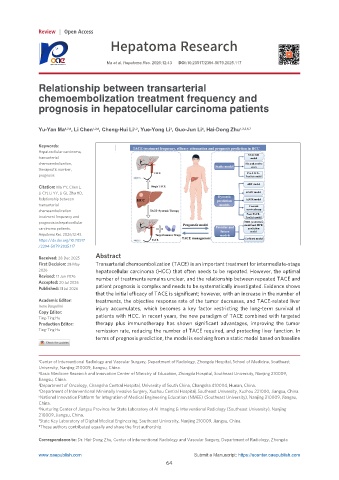
               First Decision: 28 May  Transarterial chemoembolization (TACE) is an important treatment for intermediate-stage
               2026                hepatocellular carcinoma (HCC) that often needs to be repeated. However, the optimal
               Revised: 17 Jun 2026  number of treatments remains unclear, and the relationship between repeated TACE and
               Accepted: 20 Jul 2026  patient prognosis is complex and needs to be systematically investigated. Evidence shows
               Published: 31 Jul 2026
                                   that the initial efficacy of TACE is significant; however, with an increase in the number of
               Academic Editor:    treatments, the objective response rate of the tumor decreases, and TACE-related liver
               Irene Bargellini    injury   accumulates,   which   becomes   a   key   factor   restricting   the   long-term   survival   of
               Copy Editor:
               Ting-Ting Hu        patients with HCC. In recent years, the new paradigm of TACE combined with targeted
               Production Editor:  therapy   plus   immunotherapy   has   shown   significant   advantages,   improving   the   tumor
               Ting-Ting Hu        remission rate, reducing the number of TACE required, and protecting liver function. In
                                   terms of prognosis prediction, the model is evolving from a static model based on baseline


               1 Center of Interventional Radiology and Vascular Surgery, Department of Radiology, Zhongda Hospital, School of Medicine, Southeast
               University, Nanjing 210009, Jiangsu, China.
               2 Basic Medicine Research and Innovation Center of Ministry of Education, Zhongda Hospital, Southeast University, Nanjing 210009,
               Jiangsu, China.
               3 Department of Oncology, Changsha Central Hospital, University of South China, Changsha 410004, Hunan, China.
               4 Department of Interventional Minimally Invasive Surgery, Xuzhou Central Hospital, Southeast University, Xuzhou 221000, Jiangsu, China.
               5 National Innovation Platform for Integration of Medical Engineering Education (NMEE) (Southeast University), Nanjing 210009, Jiangsu,
               China.
               6 Nurturing Center of Jiangsu Province for State Laboratory of AI Imaging & Interventional Radiology (Southeast University), Nanjing
               210009, Jiangsu, China.
               7 State Key Laboratory of Digital Medical Engineering, Southeast University, Nanjing 210009, Jiangsu, China.
               # These authors contributed equally and share the first authorship.

               Correspondence to: Dr. Hai-Dong Zhu, Center of Interventional Radiology and Vascular Surgery, Department of Radiology, Zhongda

               www.oaepublish.com                                    Submit a Manuscript: https://ucenter.oaepublish.com

