


Page 25 - Read Online
P. 25
Li et al. Hepatoma Res. 2025;11:25  https://dx.doi.org/10.20517/2394-5079.2025.63  Page 3 of 17


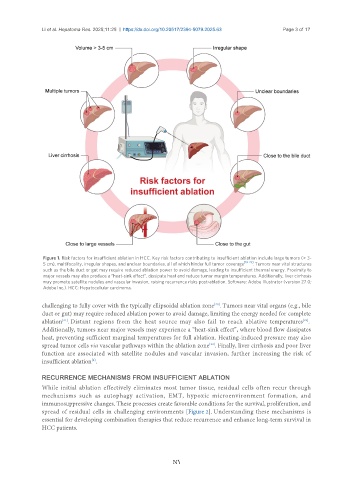
                Figure 1. Risk factors for insufficient ablation in HCC. Key risk factors contributing to insufficient ablation include large tumors (> 3-
                5 cm), multifocality, irregular shapes, and unclear boundaries, all of which hinder full tumor coverage [19-23] . Tumors near vital structures
                such as the bile duct or gut may require reduced ablation power to avoid damage, leading to insufficient thermal energy. Proximity to
                major vessels may also produce a “heat-sink effect”, dissipate heat and reduce tumor margin temperatures. Additionally, liver cirrhosis
                may promote satellite nodules and vascular invasion, raising recurrence risks post-ablation. Software: Adobe Illustrator (version 27.0;
                Adobe Inc.). HCC: Hepatocellular carcinoma.


                                                                         [20]
               challenging to fully cover with the typically ellipsoidal ablation zone . Tumors near vital organs (e.g., bile
               duct or gut) may require reduced ablation power to avoid damage, limiting the energy needed for complete
                                                                                                       [22]
               ablation . Distant  regions  from  the  heat  source  may  also  fail  to  reach  ablative  temperatures .
                      [21]
               Additionally, tumors near major vessels may experience a “heat-sink effect”, where blood flow dissipates
               heat, preventing sufficient marginal temperatures for full ablation. Heating-induced pressure may also
               spread tumor cells via vascular pathways within the ablation zone . Finally, liver cirrhosis and poor liver
                                                                        [23]
               function are associated with satellite nodules and vascular invasion, further increasing the risk of
               insufficient ablation .
                                [5]

               RECURRENCE MECHANISMS FROM INSUFFICIENT ABLATION
               While initial ablation effectively eliminates most tumor tissue, residual cells often recur through
               mechanisms  such  as  autophagy  activation,  EMT,  hypoxic  microenvironment  formation,  and
               immunosuppressive changes. These processes create favorable conditions for the survival, proliferation, and
               spread of residual cells in challenging environments [Figure 2]. Understanding these mechanisms is
               essential for developing combination therapies that reduce recurrence and enhance long-term survival in
               HCC patients.

