


Page 47 - Read Online
P. 47
Page 47                                  Racchetti et al. Extracell Vesicles Circ Nucleic Acids 2023;4:44-58  https://dx.doi.org/10.20517/evcna.2023.03


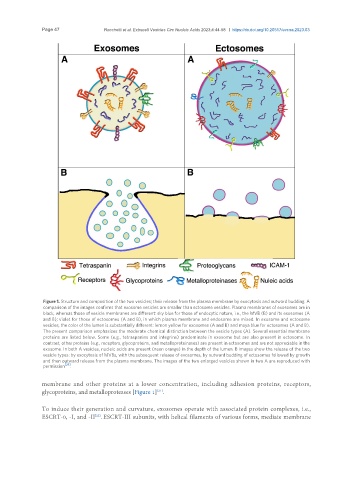
                Figure 1. Structure and composition of the two vesicles; their release from the plasma membrane by exocytosis and outward budding. A
                comparison of the images confirms that exosome vesicles are smaller than ectosome vesicles. Plasma membranes of exosomes are in
                black, whereas those of vesicle membranes are different: sky blue for those of endocytic nature, i.e., the MVB (B) and its exosomes (A
                and B); violet for those of ectosomes (A and B), in which plasma membrane and endosome are mixed. In exosome and ectosome
                vesicles, the color of the lumen is substantially different: lemon yellow for exosomes (A and B) and maya blue for ectosomes (A and B).
                The present comparison emphasizes the moderate chemical distinction between the vesicle types (A). Several essential membrane
                proteins are listed below. Some (e.g., tetraspanins and integrins) predominate in exosome but are also present in ectosome. In
                contrast, other proteins (e.g., receptors, glycoproteins, and metalloproteinases) are present in ectosomes and are not appreciable in the
                exosome. In both A vesicles, nucleic acids are present (neon orange) in the depth of the lumen. B images show the release of the two
                vesicle types: by exocytosis of MVBs, with the subsequent release of exosomes, by outward budding of ectosomes followed by growth
                and then outward release from the plasma membrane. The images of the two enlarged vesicles shown in two A are reproduced with
                permission [26] .

               membrane and other proteins at a lower concentration, including adhesion proteins, receptors,
               glycoproteins, and metalloproteases [Figure 1] .
                                                      [21]
               To induce their generation and curvature, exosomes operate with associated protein complexes, i.e.,
               ESCRT-0, -I, and -II . ESCRT-III subunits, with helical filaments of various forms, mediate membrane
                                 [22]

