


Page 105 - Read Online
P. 105
Tutanov et al. Extracell Vesicles Circ Nucleic Acids 2023;4:195-217  https://dx.doi.org/10.20517/evcna.2023.17                                   Page 203


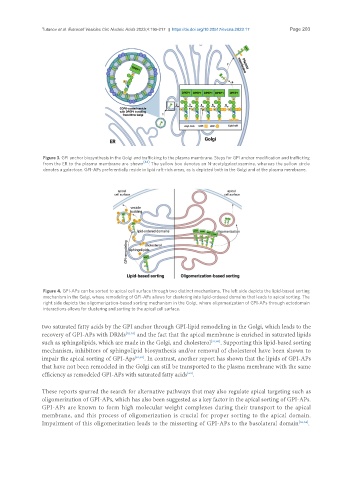
                Figure 3. GPI anchor biosynthesis in the Golgi and trafficking to the plasma membrane. Steps for GPI anchor modification and trafficking
                from the ER to the plasma membrane are  shown [44] . The yellow box denotes an N-acetylgalactosamine, whereas the yellow circle
                denotes a galactose. GPI-APs preferentially reside in lipid raft-rich areas, as is depicted both in the Golgi and at the plasma membrane.


                Figure 4. GPI-APs can be sorted to apical cell surface through two distinct mechanisms. The left side depicts the lipid-based sorting
                mechanism in the Golgi, where remodeling of GPI-APs allows for clustering into lipid-ordered domains that leads to apical sorting. The
                right side depicts the oligomerization-based sorting mechanism in the Golgi, where oligomerization of GPI-APs through ectodomain
                interactions allows for clustering and sorting to the apical cell surface.

               two saturated fatty acids by the GPI anchor through GPI-lipid remodeling in the Golgi, which leads to the
               recovery of GPI-APs with DRMs [52,53]  and the fact that the apical membrane is enriched in saturated lipids
               such as sphingolipids, which are made in the Golgi, and cholesterol [37,60] . Supporting this lipid-based sorting
               mechanism, inhibitors of sphingolipid biosynthesis and/or removal of cholesterol have been shown to
               impair the apical sorting of GPI-Aps [61,62] . In contrast, another report has shown that the lipids of GPI-APs
               that have not been remodeled in the Golgi can still be transported to the plasma membrane with the same
               efficiency as remodeled GPI-APs with saturated fatty acids .
                                                                [63]

               These reports spurred the search for alternative pathways that may also regulate apical targeting such as
               oligomerization of GPI-APs, which has also been suggested as a key factor in the apical sorting of GPI-APs.
               GPI-APs are known to form high molecular weight complexes during their transport to the apical
               membrane, and this process of oligomerization is crucial for proper sorting to the apical domain.
               Impairment of this oligomerization leads to the missorting of GPI-APs to the basolateral domain [62,64] .

