


Page 82 - Read Online
P. 82
Kühn et al. Energy Mater 2023;3:300020  https://dx.doi.org/10.20517/energymater.2023.07  Page 3 of 14


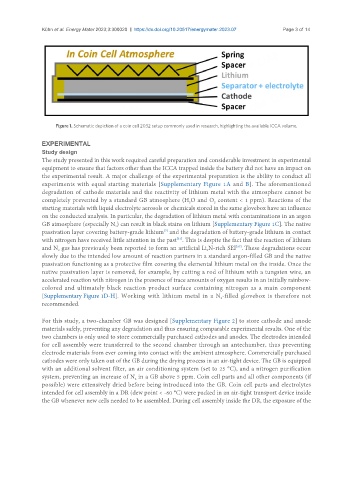
                    Figure 1. Schematic depiction of a coin cell 2032 setup commonly used in research, highlighting the available ICCA volume.


               EXPERIMENTAL
               Study design
               The study presented in this work required careful preparation and considerable investment in experimental
               equipment to ensure that factors other than the ICCA trapped inside the battery did not have an impact on
               the experimental result. A major challenge of the experimental preparation is the ability to conduct all
               experiments with equal starting materials [Supplementary Figure 1A and B]. The aforementioned
               degradation of cathode materials and the reactivity of lithium metal with the atmosphere cannot be
               completely prevented by a standard GB atmosphere (H O and O  content < 1 ppm). Reactions of the
                                                                         2
                                                                 2
               starting materials with liquid electrolyte aerosols or chemicals stored in the same glovebox have an influence
               on the conducted analysis. In particular, the degradation of lithium metal with contaminations in an argon
               GB atmosphere (especially N ) can result in black stains on lithium [Supplementary Figure 1C]. The native
                                        2
                                                        [7]
               passivation layer covering battery-grade lithium  and the degradation of battery-grade lithium in contact
               with nitrogen have received little attention in the past . This is despite the fact that the reaction of lithium
                                                             [31]
               and N  gas has previously been reported to form an artificial Li N-rich SEI . These degradations occur
                                                                                 [37]
                     2
                                                                       3
               slowly due to the intended low amount of reaction partners in a standard argon-filled GB and the native
               passivation functioning as a protective film covering the elemental lithium metal on the inside. Once the
               native passivation layer is removed, for example, by cutting a rod of lithium with a tungsten wire, an
               accelerated reaction with nitrogen in the presence of trace amounts of oxygen results in an initially rainbow-
               colored and ultimately black reaction product surface containing nitrogen as a main component
               [Supplementary Figure 1D-H]. Working with lithium metal in a N -filled glovebox is therefore not
                                                                           2
               recommended.

               For this study, a two-chamber GB was designed [Supplementary Figure 2] to store cathode and anode
               materials safely, preventing any degradation and thus ensuring comparable experimental results. One of the
               two chambers is only used to store commercially purchased cathodes and anodes. The electrodes intended
               for cell assembly were transferred to the second chamber through an antechamber, thus preventing
               electrode materials from ever coming into contact with the ambient atmosphere. Commercially purchased
               cathodes were only taken out of the GB during the drying process in an air-tight device. The GB is equipped
               with an additional solvent filter, an air conditioning system (set to 25 °C), and a nitrogen purification
               system, preventing an increase of N  in a GB above 5 ppm. Coin cell parts and all other components (if
                                              2
               possible) were extensively dried before being introduced into the GB. Coin cell parts and electrolytes
               intended for cell assembly in a DR (dew point < -60 °C) were packed in an air-tight transport device inside
               the GB whenever new cells needed to be assembled. During cell assembly inside the DR, the exposure of the

