


Page 15 - Read Online
P. 15
Page 8 of 34                                                 Wang et al. Energy Mater. 2026, 6, 600064


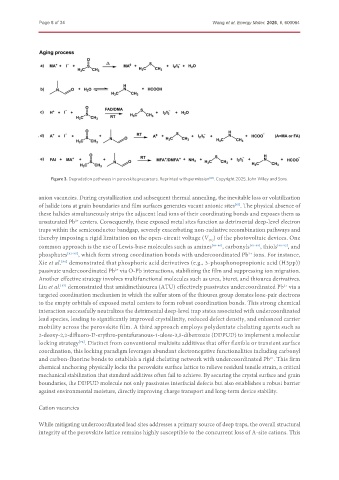
                   Figure 3. Degradation pathways in perovskite precursors. Reprinted with permission . Copyright 2025, John Wiley and Sons.
                                                                           [81]
               anion vacancies. During crystallization and subsequent thermal annealing, the inevitable loss or volatilization
               of halide ions at grain boundaries and film surfaces generates vacant anionic sites . The physical absence of
                                                                                   [83]
               these halides simultaneously strips the adjacent lead ions of their coordinating bonds and exposes them as
               unsaturated Pb  centers. Consequently, these exposed metal sites function as detrimental deep-level electron
                           2+
               traps within the semiconductor bandgap, severely exacerbating non-radiative recombination pathways and
               thereby imposing a rigid limitation on the open-circuit voltage (V ) of the photovoltaic devices. One
                                                                          OC
               common approach is the use of Lewis-base molecules such as amines [84-86] , carbonyls [87-89] , thiols [90-92] , and
               phosphates [93-95] , which form strong coordination bonds with undercoordinated Pb  ions. For instance,
                                                                                        2+
               Xie et al.  demonstrated that phosphoric acid derivatives (e.g., 3-phosphonopropionic acid (H3pp))
                       [96]
               passivate undercoordinated Pb  via O-Pb interactions, stabilizing the film and suppressing ion migration.
                                         2+
               Another effective strategy involves multifunctional molecules such as urea, biuret, and thiourea derivatives.
               Liu et al.  demonstrated that amidinethiourea (ATU) effectively passivates undercoordinated Pb  via a
                      [97]
                                                                                                     2+
               targeted coordination mechanism in which the sulfur atom of the thiourea group donates lone-pair electrons
               to the empty orbitals of exposed metal centers to form robust coordination bonds. This strong chemical
               interaction successfully neutralizes the detrimental deep-level trap states associated with undercoordinated
               lead species, leading to significantly improved crystallinity, reduced defect density, and enhanced carrier
               mobility across the perovskite film. A third approach employs polydentate chelating agents such as
               2-deoxy-2,2-difluoro-D-erythro-pentafuranous-1-ulose-3,5-dibenzoate (DDPUD) to implement a molecular
               locking strategy . Distinct from conventional multisite additives that offer flexible or transient surface
                             [74]
               coordination, this locking paradigm leverages abundant electronegative functionalities including carbonyl
               and carbon-fluorine bonds to establish a rigid chelating network with undercoordinated Pb . This firm
                                                                                                2+
               chemical anchoring physically locks the perovskite surface lattice to relieve residual tensile strain, a critical
               mechanical stabilization that standard additives often fail to achieve. By securing the crystal surface and grain
               boundaries, the DDPUD molecule not only passivates interfacial defects but also establishes a robust barrier
               against environmental moisture, directly improving charge transport and long-term device stability.

               Cation vacancies


               While mitigating undercoordinated lead sites addresses a primary source of deep traps, the overall structural
               integrity of the perovskite lattice remains highly susceptible to the concurrent loss of A-site cations. This

