


Page 14 - Read Online
P. 14
Wang et al. Energy Mater. 2026, 6, 600064                                         Page 7 of 34


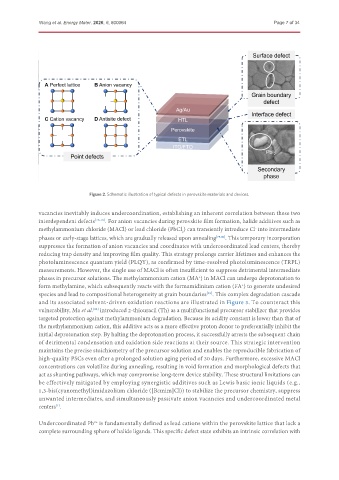
                                Figure 2. Schematic illustration of typical defects in perovskite materials and devices.


               vacancies inevitably induces undercoordination, establishing an inherent correlation between these two
               interdependent defects [76-78] . For anion vacancies during perovskite film formation, halide additives such as
               methylammonium chloride (MACl) or lead chloride (PbCl ) can transiently introduce Cl  into intermediate
                                                                                           -
                                                                 2
               phases or early-stage lattices, which are gradually released upon annealing [79,80] . This temporary incorporation
               suppresses the formation of anion vacancies and coordinates with undercoordinated lead centers, thereby
               reducing trap density and improving film quality. This strategy prolongs carrier lifetimes and enhances the
               photoluminescence quantum yield (PLQY), as confirmed by time-resolved photoluminescence (TRPL)
               measurements. However, the single use of MACl is often insufficient to suppress detrimental intermediate
               phases in precursor solutions. The methylammonium cation (MA ) in MACl can undergo deprotonation to
                                                                       +
               form methylamine, which subsequently reacts with the formamidinium cation (FA ) to generate undesired
                                                                                      +
               species and lead to compositional heterogeneity at grain boundaries . This complex degradation cascade
                                                                          [81]
               and its associated solvent-driven oxidation reactions are illustrated in Figure 3. To counteract this
               vulnerability, Ma et al.  introduced 2‐thiouracil (Th) as a multifunctional precursor stabilizer that provides
                                  [82]
               targeted protection against methylammonium degradation. Because its acidity constant is lower than that of
               the methylammonium cation, this additive acts as a more effective proton donor to preferentially inhibit the
               initial deprotonation step. By halting the deprotonation process, it successfully arrests the subsequent chain
               of detrimental condensation and oxidation side reactions at their source. This strategic intervention
               maintains the precise stoichiometry of the precursor solution and enables the reproducible fabrication of
               high-quality PSCs even after a prolonged solution aging period of 30 days. Furthermore, excessive MACl
               concentrations can volatilize during annealing, resulting in void formation and morphological defects that
               act as shunting pathways, which may compromise long-term device stability. These structural limitations can
               be effectively mitigated by employing synergistic additives such as Lewis basic ionic liquids (e.g.,
               1,3-bis(cyanomethyl)imidazolium chloride ([Bcmim]Cl)) to stabilize the precursor chemistry, suppress
               unwanted intermediates, and simultaneously passivate anion vacancies and undercoordinated metal
               centers .
                     [1]

               Undercoordinated Pb  is fundamentally defined as lead cations within the perovskite lattice that lack a
                                  2+
               complete surrounding sphere of halide ligands. This specific defect state exhibits an intrinsic correlation with

