


Page 70 - 2417
P. 70
Original Article  |  Open Access

                                          Carbon Footprints


                                       Salmerón et al. Carbon Footprints 2026, 5, 17      DOI:10.20517/cf.2025.112


               Life-cycle environmental analysis of combined
               biochar and agrivoltaic systems in Andalusian olive
               groves


               María Salmerón, Francesco Cherubini, Nariê Rinke Dias de Souza

               Keywords:
               Life cycle assessment,
               carbon sequestration,
               climate mitigation,
               sustainable agriculture, solar
               power, soil erosion, energy
               transition

               Citation: Salmerón, M.;
               Cherubini, F.; Dias de
               Souza, N. R. Life-cycle
               environmental analysis of
               combined biochar and
               agrivoltaic systems in
               Andalusian olive groves.
               Carbon Footprints 2026, 5, 17.
               https://dx.doi.org/10.20517
               /cf.2025.112
                                   Abstract
               Received: 28 Nov 2025
               First Decision: 5 Jan 2026  Agricultural   activities   in   Spain   are   increasingly   vulnerable   to   water   scarcity   and   soil
               Revised: 19 Jan 2026  degradation, exacerbated by farming intensification and climate change. Alongside, the
               Accepted: 30 Jan 2026  need for renewable energy generation expansion and negative emission technologies risk
               Published: 18 Mar 2026
                                   increasing   land   use   conflicts.   Sustainable   strategies   to   reconcile   measures   to   improve
               Academic Editor:    agricultural resilience with the renewable energy transition should be explored. This study
               Reinout Heijungs    evaluates the life-cycle environmental performance of integrating biochar production from
               Copy Editor:        residues from the local olive oil value chain with agrivoltaic systems in Andalusian olive
               Fangling Lan        groves. Five scenarios consider various constraints for regional biomass availability and for
               Production Editor:
               Fangling Lan        agrivoltaic deployment. A spatial analysis identifies the olive groves that are most suitable
                                   for   agrivoltaic   installation   and   prioritizes   high-erosion   groves   for   biochar   application.
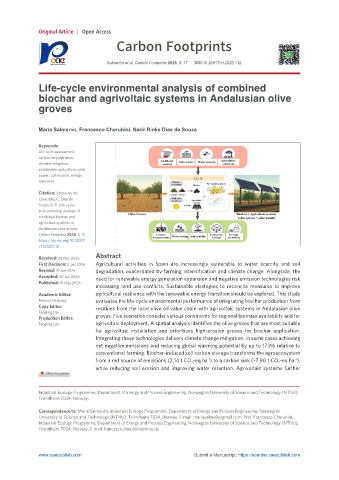
                                   Integrating these technologies delivers climate change mitigation, in some cases achieving
                                   net negative emissions and reducing global warming potential by up to 173% relative to
                                   conventional farming. Biochar-induced soil carbon storage transforms the agroecosystem
                                   from a net source of emissions (2.14 t CO 2 -eq ha ) to a carbon sink (-7.90 t CO 2 -eq ha ),
                                                                          -1
                                                                                                        -1
                                   while   reducing   soil   erosion   and   improving   water   retention.   Agrivoltaic   systems   further


               Industrial Ecology Programme, Department of Energy and Process Engineering, Norwegian University of Science and Technology (NTNU),
               Trondheim 7034, Norway.

               Correspondence to: María Salmerón, Industrial Ecology Programme, Department of Energy and Process Engineering, Norwegian
               University of Science and Technology (NTNU), Trondheim 7034, Norway. E-mail: mariasalme9@gmail.com; Prof. Francesco Cherubini,
               Industrial Ecology Programme, Department of Energy and Process Engineering, Norwegian University of Science and Technology (NTNU),
               Trondheim 7034, Norway. E-mail: francesco.cherubini@ntnu.no


               www.oaepublish.com                                    Submit a Manuscript: https://ucenter.oaepublish.com

