


Page 45 - Read online
P. 45
Original Article  |  Open Access

                                          Carbon Footprints


                                      Diaz-Vallejo et al. Carbon Footprints 2026, 5, 12      DOI:10.20517/cf.2025.103


               Defining soil carbon benchmark values of
               agroecosystems across a diversity of tropical soil
               environments


               Emily J. Diaz-Vallejo 1,2  , Elliot Vaughan 3  , David Sotomayor , Manuel Matos , Samuel Rios , Carmen
                                                                                 5
                                                                   4
                                                                                             5
               Santiago , Erika Marin-Spiotta 1
                      5
               Keywords:
               Soil organic carbon, land-use
               change, benchmark
               modeling, agroecosystems

               Citation: Diaz-Vallejo, E. J.;
               Vaughan, E.; Sotomayor, D.;
               Matos, M.; Rios, S.;
               Santiago, C.;
               Marin-Spiotta, E. Defining
               soil carbon benchmark
               values of agroecosystems
               across a diversity of tropical
               soil environments. Carbon
               Footprints 2026, 5, 12.
               https://dx.doi.org/10.20517
               /cf.2025.103
               Received: 31 Oct 2025
               First Decision: 26 Dec  Abstract
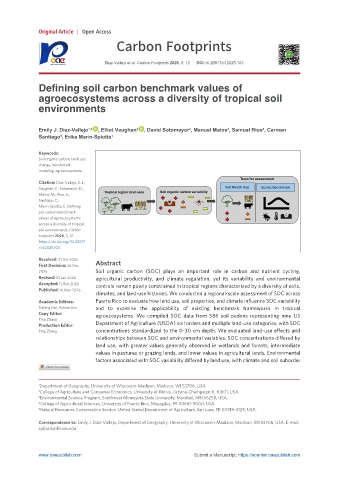
               2025                Soil   organic   carbon   (SOC)   plays   an   important   role   in   carbon   and   nutrient   cycling,
               Revised: 23 Jan 2026  agricultural   productivity,   and   climate   regulation,   yet   its   variability   and   environmental
               Accepted: 12 Feb 2026  controls remain poorly constrained in tropical regions characterized by a diversity of soils,
               Published: 16 Mar 2026
                                   climates, and land-use histories. We conducted a regional-scale assessment of SOC across
               Academic Editors:   Puerto Rico to evaluate how land use, soil properties, and climate influence SOC variability
               Dafeng Hui, Adrian Unc  and   to   examine   the   applicability   of   existing   benchmark   frameworks   in   tropical
               Copy Editor:        agroecosystems.   We   compiled   SOC   data   from   586   soil   pedons   representing   nine   US
               Ping Zhang
               Production Editor:  Department of Agriculture (USDA) soil orders and multiple land-use categories, with SOC
               Ping Zhang          concentrations standardized to the 0-30 cm depth. We evaluated land-use effects and
                                   relationships between SOC and environmental variables. SOC concentrations differed by
                                   land  use,  with  greater  values  generally  observed  in  wetlands  and  forests,  intermediate
                                   values in pastures or grazing lands, and lower values in agricultural lands. Environmental
                                   factors associated with SOC variability differed by land use, with climate and soil suborder


               1 Department of Geography, University of Wisconsin-Madison, Madison, WI 53706, USA.
               2 College of Agriculture and Consumer Economics, University of Illinois, Urbana-Champaign, IL 61801, USA.
               3 Environmental Science Program, Southwest Minnesota State University, Marshall, MN 56258, USA.
               4 College of Agricultural Sciences, University of Puerto Rico, Mayagüez, PR 00681-9000, USA.
               5 Natural Resources Conservation Service, United Stated Department of Agriculture, San Juan, PR 00918-4129, USA.

               Correspondence to: Emily J. Diaz-Vallejo, Department of Geography, University of Wisconsin-Madison, Madison, WI 53706, USA. E-mail:
               ejdiaz3@illinois.edu


               www.oaepublish.com                                    Submit a Manuscript: https://ucenter.oaepublish.com

