


Page 50 - Read Online
P. 50
Page 8 of 16                    Watts et al. Carbon Footprints 2025, 4, 27  https://dx.doi.org/10.20517/cf.2025.20

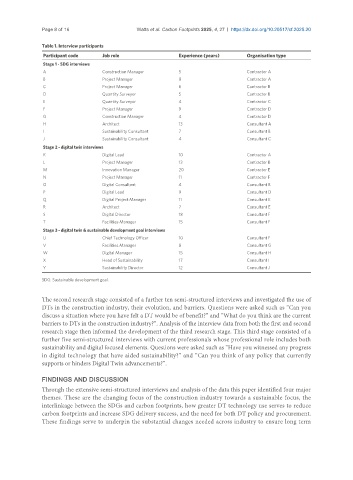
               Table 1. Interview participants
                Participant code    Job role                 Experience (years)     Organisation type
                Stage 1 - SDG interviews
                A                   Construction Manager     5                      Contractor A
                B                   Project Manager          8                      Contractor A
                C                   Project Manager          6                      Contractor B
                D                   Quantity Surveyor        5                      Contractor B
                E                   Quantity Surveyor        4                      Contractor C
                F                   Project Manager          9                      Contractor D
                G                   Construction Manager     4                      Contractor D
                H                   Architect                13                     Consultant A
                I                   Sustainability Consultant  7                    Consultant B
                J                   Sustainability Consultant  4                    Consultant C
                Stage 2 - digital twin interviews
                K                   Digital Lead             10                     Contractor A
                L                   Project Manager          13                     Contractor B
                M                   Innovation Manager       20                     Contractor E
                N                   Project Manager          11                     Contractor F
                O                   Digital Consultant       4                      Consultant B
                P                   Digital Lead             9                      Consultant D
                Q                   Digital Project Manager  11                     Consultant E
                R                   Architect                7                      Consultant E
                S                   Digital Director         18                     Consultant F
                T                   Facilities Manager       15                     Consultant F
                Stage 3 - digital twin & sustainable development goal interviews
                U                   Chief Technology Officer  10                    Consultant F
                V                   Facilities Manager       8                      Consultant G
                W                   Digital Manager          15                     Consultant H
                X                   Head of Sustainability   17                     Consultant I
                Y                   Sustainability Director  12                     Consultant J
               SDG: Sustainable development goal.


               The second research stage consisted of a further ten semi-structured interviews and investigated the use of
               DTs in the construction industry, their evolution, and barriers. Questions were asked such as “Can you
               discuss a situation where you have felt a DT would be of benefit?” and “What do you think are the current
               barriers to DTs in the construction industry?”. Analysis of the interview data from both the first and second
               research stage then informed the development of the third research stage. This third stage consisted of a
               further five semi-structured interviews with current professionals whose professional role includes both
               sustainability and digital focused elements. Questions were asked such as “Have you witnessed any progress
               in digital technology that have aided sustainability?” and “Can you think of any policy that currently
               supports or hinders Digital Twin advancements?”.

               FINDINGS AND DISCUSSION
               Through the extensive semi-structured interviews and analysis of the data this paper identified four major
               themes. These are the changing focus of the construction industry towards a sustainable focus, the
               interlinkage between the SDGs and carbon footprints, how greater DT technology use serves to reduce
               carbon footprints and increase SDG delivery success, and the need for both DT policy and procurement.
               These findings serve to underpin the substantial changes needed across industry to ensure long term

