


Page 89 - Read Online
P. 89
Wei et al. Art Int Surg 2024;4:187-98  I http://dx.doi.org/10.20517/ais.2024.12     Page 195


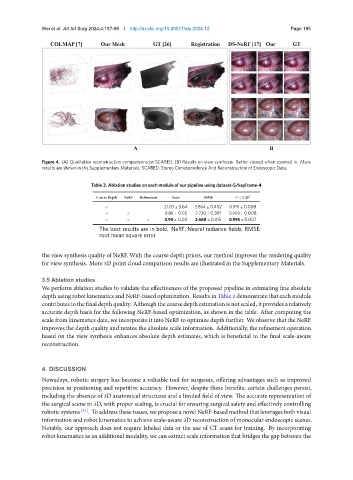
               Figure 4. (A) Qualitative reconstruction comparisons on SCARED; (B) Results on view synthesis. Better viewed when zoomed in. More
               results are shown in the Supplementary Materials. SCARED: Stereo Correspondence And Reconstruction of Endoscopic Data.

                                Table 3. Ablation studies on each module of our pipeline using dataset-5/keyframe-4

                                  Coarse Depth  NeRF  Refinement  Scale  RMSE      < 1.25 1
                                     ✓                  21.83 ± 3.64  2.864 ± 0.452  0.991 ± 0.008
                                     ✓      ✓            0.89 ± 0.05  2.730 ± 0.391  0.993 ± 0.008
                                     ✓      ✓      ✓    0.90 ± 0.04  2.688 ± 0.415  0.995 ± 0.007
                                  The best results are in bold. NeRF: Neural radiance fields; RMSE:
                                   root mean square error.


               the view synthesis quality of NeRF. With the coarse depth priors, our method improves the rendering quality
               for view synthesis. More 3D point cloud comparison results are illustrated in the Supplementary Materials.

               3.5 Ablation studies
               We perform ablation studies to validate the effectiveness of the proposed pipeline in estimating fine absolute
               depth using robot kinematics and NeRF-based optimization. Results in Table 3 demonstrate that each module
               contributestothefinaldepthquality. Although thecoarsedepthestimationisnotscaled, itprovidesarelatively
               accurate depth basis for the following NeRF-based optimization, as shown in the table. After computing the
               scale from kinematics data, we incorporate it into NeRF to optimize depth further. We observe that the NeRF
               improves the depth quality and retains the absolute scale information. Additionally, the refinement operation
               based on the view synthesis enhances absolute depth estimates, which is beneficial to the final scale-aware
               reconstruction.


               4. DISCUSSION
               Nowadays, robotic surgery has become a valuable tool for surgeons, offering advantages such as improved
               precision in positioning and repetitive accuracy. However, despite these benefits, certain challenges persist,
               including the absence of 3D anatomical structures and a limited field of view. The accurate representation of
               the surgical scene in 3D, with proper scaling, is crucial for ensuring surgical safety and effectively controlling
               robotic systems [31] . To address these issues, we propose a novel NeRF-based method that leverages both visual
               information and robot kinematics to achieve scale-aware 3D reconstruction of monocular endoscopic scenes.
               Notably, our approach does not require labeled data or the use of CT scans for training. By incorporating
               robot kinematics as an additional modality, we can extract scale information that bridges the gap between the

