


Page 70 - Read Online
P. 70
Oliver et al. Plast Aesthet Res. 2025;12:19  https://dx.doi.org/10.20517/2347-9264.2025.11                                 Page 11 of 16

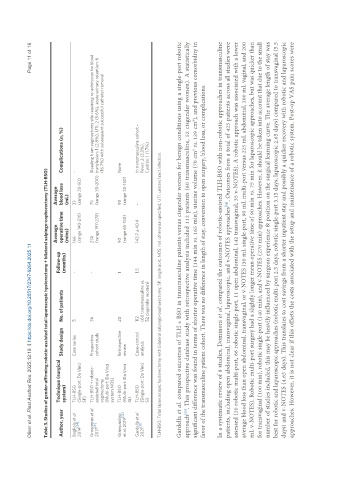
               Table 3. Studies of gender-affirming robotic-assisted total laparoscopic hysterectomy + bilateral salpingo-oophorectomy (TLH-BSO)
                                                                                 Average      Average
                           Technique (surgical                         Follow-up
                Author, year               Study design  No. of patients         operative time   blood loss   Complications (n, %)
                           system)                                     (months)  (mins)       (mL)
                Bogliolo et al.   TLH-BSO   Case series  5             -         166          33        -
                   [34]
                2014       (Single-port: Da Vinci                                (range 140-210)  (range 20-50)
                           SP)
                Groenman et al.  TLH-BSO + robotic-  Prospective   36  -         230          75        Bleeding from vaginectomy site requiring re-admission for blood
                2017 [21]  assisted total   cohort study                         (range 197-278)  (range 30-200) transfusion: 1 (2.8%), UTI: 2 (5.6%), acute urinary retention: 6
                           vaginectomy                                                                  (16.7%) with subsequent successful catheter removal
                           (Multi-port: Da Vinci
                           system NOS)
                Giampaolino   TLH-BSO      Retrospective   20          1         90           90        None
                et al. 2019 [33]  (Multi-port: Da Vinci   review                 (range 65-150)  (range 30-150)
                           Xi)
                Gardella et al.   TLH-BSO   Case-control   112         1.5       143.7 ± 40.4  -        In transmasculine cohort -
                   [35]
                2021       (Single-port: Da Vinci   analysis  (60 transmasculine vs.                    Fever: 2 (3.3%),
                           Si)                        52 cisgender women)                               Cystitis: 1 (1.7%)
               TLH-BSO: Total laparoscopic hysterectomy with bilateral salpingo-oophorectomy; SP: single port; NOS: not otherwise specified; UTI: urinary tract infection.


               Gardella et al. compared outcomes of TLH ± BSO in transmasculine patients versus cisgender women for benign conditions using a single-port robotic
                       [35]
               approach . This prospective database study with retrospective analysis included 112 patients (60 transmasculine, 52 cisgender women). A statistically
               significant difference was found in terms of shorter operative time (144 min vs. 165 min), uterine volume (70 cm  vs. 129 cm ), and previous comorbidity in
                                                                                                                          3
                                                                                                                3
               favor of the transmasculine patient cohort. There was no difference in length of stay, conversion to open surgery, blood loss, or complications.
               In a systematic review of 8 studies, Dominoni et al. compared the outcomes of robotic-assisted TLH-BSO with non-robotic approaches in transmasculine
                                                                                             [36]
               patients, including open abdominal, transvaginal, laparoscopic, and v-NOTES approaches . Outcomes from a total of 425 patients across all studies were
               assessed (20 robotic multi-port, 66 robotic single-port, 11 open abdominal, 142 transvaginal, 35 v-NOTES). A robotic approach was associated with a lower
               average blood loss than open abdominal, transvaginal, or v-NOTES (30 mL single-port, 90 mL multi-port versus 225 mL abdominal, 200 mL vaginal, and 200
               mL v-NOTES). Robotic multi-port surgery had a slightly longer mean operative time of 90 min vs. 75 min for laparoscopic approaches, but was quicker than
               for transvaginal (100 min), robotic single-port (140 min), and v-NOTES (270 min) approaches. However, it should be taken into account that due to the small
               number of studies included, this may be heavily influenced by surgeon experience & position on the surgical learning curve. The average length of stay was
               best for robotic and laparoscopic approaches (robotic multi-port 2.5 days, robotic single-port 3.15 days, laparoscopic 2.65 days) compared to transvaginal (5.5
               days) and v-NOTES (4.65 days). This translates to cost savings from a shorter inpatient stay and possibly a quicker recovery with robotic and laparoscopic
               approaches. However, it is not clear if this offsets the costs associated with the setup and maintenance of a robotic system. Post-op VAS pain scores were

