


Page 148 - Read Online
P. 148
Page 8 of 13           Ramirez et al. Plast Aesthet Res. 2025;12:16  https://dx.doi.org/10.20517/2347-9264.2025.10


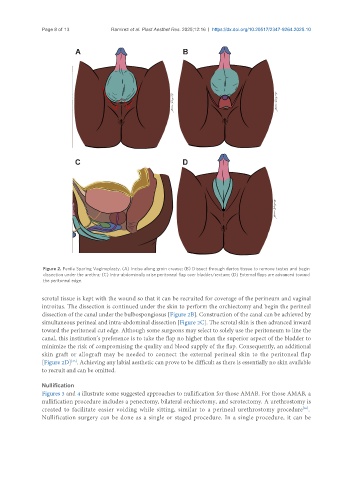
                Figure 2. Penile Sparing Vaginoplasty. (A) Incise along groin crease; (B) Dissect through dartos tissue to remove testes and begin
                dissection under the urethra; (C) Intra-abdominally raise peritoneal flap over bladder/rectum; (D) External flaps are advanced toward
                the peritoneal edge.

               scrotal tissue is kept with the wound so that it can be recruited for coverage of the perineum and vaginal
               introitus. The dissection is continued under the skin to perform the orchiectomy and begin the perineal
               dissection of the canal under the bulbospongiosus [Figure 2B]. Construction of the canal can be achieved by
               simultaneous perineal and intra-abdominal dissection [Figure 2C]. The scrotal skin is then advanced inward
               toward the peritoneal cut edge. Although some surgeons may select to solely use the peritoneum to line the
               canal, this institution’s preference is to take the flap no higher than the superior aspect of the bladder to
               minimize the risk of compromising the quality and blood supply of the flap. Consequently, an additional
               skin graft or allograft may be needed to connect the external perineal skin to the peritoneal flap
               [Figure 2D] . Achieving any labial aesthetic can prove to be difficult as there is essentially no skin available
                         [35]
               to recruit and can be omitted.


               Nullification
               Figures 3 and 4 illustrate some suggested approaches to nullification for those AMAB. For those AMAB, a
               nullification procedure includes a penectomy, bilateral orchiectomy, and scrotectomy. A urethrostomy is
               created to facilitate easier voiding while sitting, similar to a perineal urethrostomy procedure .
                                                                                                       [36]
               Nullification surgery can be done as a single or staged procedure. In a single procedure, it can be

