


Page 145 - Read Online
P. 145
Ramirez et al. Plast Aesthet Res. 2025;12:16  https://dx.doi.org/10.20517/2347-9264.2025.10  Page 5 of 13

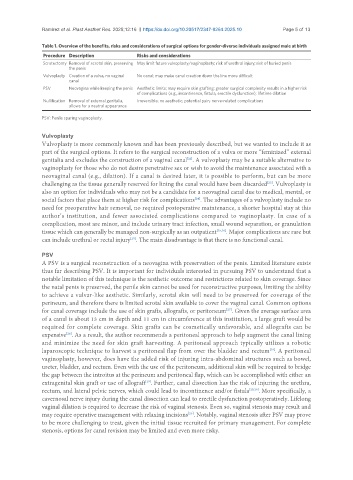
               Table 1. Overview of the benefits, risks and considerations of surgical options for gender-diverse individuals assigned male at birth
                Procedure Description          Risks and considerations
                Scrotectomy Removal of scrotal skin, preserving  May limit future vulvoplasty/vaginoplasty; risk of urethral injury; risk of buried penis
                        the penis
                Vulvoplasty Creation of a vulva, no vaginal   No canal; may make canal creation down the line more difficult
                        canal
                PSV     Neovagina while keeping the penis Aesthetic limits; may require skin grafting; greater surgical complexity results in a higher risk
                                               of complications (e.g., incontinence, fistula, erectile dysfunction); lifetime dilation
                Nullification Removal of external genitalia,   Irreversible; no aesthetic; potential pain; nerve-related complications
                        allows for a neutral appearance
               PSV: Penile sparing vaginoplasty.


               Vulvoplasty
               Vulvoplasty is more commonly known and has been previously described, but we wanted to include it as
               part of the surgical options. It refers to the surgical reconstruction of a vulva or more “feminized” external
               genitalia and excludes the construction of a vaginal canal . A vulvoplasty may be a suitable alternative to
                                                                [22]
               vaginoplasty for those who do not desire penetrative sex or wish to avoid the maintenance associated with a
               neovaginal canal (e.g., dilation). If a canal is desired later, it is possible to perform, but can be more
               challenging as the tissue generally reserved for lining the canal would have been discarded . Vulvoplasty is
                                                                                           [23]
               also an option for individuals who may not be a candidate for a neovaginal canal due to medical, mental, or
               social factors that place them at higher risk for complications . The advantages of a vulvoplasty include no
                                                                   [24]
               need for preoperative hair removal, no required postoperative maintenance, a shorter hospital stay at this
               author’s institution, and fewer associated complications compared to vaginoplasty. In case of a
               complication, most are minor, and include urinary tract infection, small wound separation, or granulation
               tissue which can generally be managed non-surgically as an outpatient [25,26] . Major complications are rare but
                                             [25]
               can include urethral or rectal injury . The main disadvantage is that there is no functional canal.
               PSV
               A PSV is a surgical reconstruction of a neovagina with preservation of the penis. Limited literature exists
               thus far describing PSV. It is important for individuals interested in pursuing PSV to understand that a
               notable limitation of this technique is the aesthetic outcome and restrictions related to skin coverage. Since
               the natal penis is preserved, the penile skin cannot be used for reconstructive purposes, limiting the ability
               to achieve a vulvar-like aesthetic. Similarly, scrotal skin will need to be preserved for coverage of the
               perineum, and therefore there is limited scrotal skin available to cover the vaginal canal. Common options
               for canal coverage include the use of skin grafts, allografts, or peritoneum . Given the average surface area
                                                                             [27]
               of a canal is about 13 cm in depth and 11 cm in circumference at this institution, a large graft would be
               required for complete coverage. Skin grafts can be cosmetically unfavorable, and allografts can be
               expensive . As a result, the author recommends a peritoneal approach to help augment the canal lining
                       [28]
               and minimize the need for skin graft harvesting. A peritoneal approach typically utilizes a robotic
               laparoscopic technique to harvest a peritoneal flap from over the bladder and rectum . A peritoneal
                                                                                            [29]
               vaginoplasty, however, does have the added risk of injuring intra-abdominal structures such as bowel,
               ureter, bladder, and rectum. Even with the use of the peritoneum, additional skin will be required to bridge
               the gap between the introitus at the perineum and peritoneal flap, which can be accomplished with either an
                                                  [29]
               extragenital skin graft or use of allograft . Further, canal dissection has the risk of injuring the urethra,
               rectum, and lateral pelvic nerves, which could lead to incontinence and/or fistula [25,26] . More specifically, a
               cavernosal nerve injury during the canal dissection can lead to erectile dysfunction postoperatively. Lifelong
               vaginal dilation is required to decrease the risk of vaginal stenosis. Even so, vaginal stenosis may result and
               may require operative management with relaxing incisions . Notably, vaginal stenosis after PSV may prove
                                                                [26]
               to be more challenging to treat, given the initial tissue recruited for primary management. For complete
               stenosis, options for canal revision may be limited and even more risky.

