


Page 21 - Read Online
P. 21
Page 6 of 11                                                        Ghosh et al. Plast Aesthet Res 2024;11:50  https://dx.doi.org/10.20517/2347-9264.2024.70

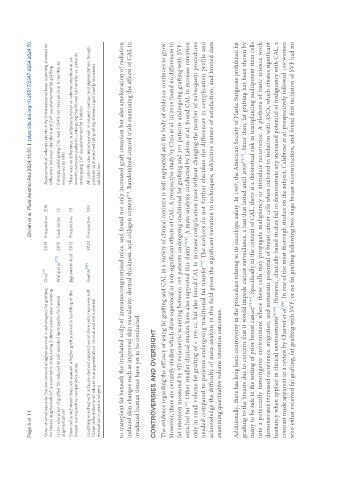
                Does stromal vascular fraction ensure a higher survival in autologous fat grafting   Chiu [72]  2019 Prospective 206  Assessment of volume retention by 3-dimensional laser scanning showed no
                for breast augmentation? a volumetric study using 3-dimensional laser scanning      difference between standard and SVF-supplemented fat grafting
                                                                          [73]
                Is the resorption of grafted fat reduced in cell-assisted lipotransfer for breast   Wang et al.  2015 Case series  12   Patients undergoing CAL had 51.84% fat resorption at 6 months as
                augmentation?                                                                       measured by MRI
                Stem cell enrichment does not warrant a higher graft survival in lipofilling of the   Peltoniemi et al. 2013 Prospective 18  There was no difference in adipose survival or volume retention at six
                                                                   [74]
                breast: a prospective comparative study                                             months between patients undergoing traditional fat transfer vs. patients
                                                                                                    undergoing SVF-supplemented fat transfer
                Lipofilling enriched with adipose-derived mesenchymal stem cells improves soft   Gentile [64]  2023 Prospective 100  All patients saw improvement in volume contour and pigmentation, though
                tissue deformities and reduces scar pigmentation: clinical and instrumental         patients with enriched fat-grafting showed significantly increased
                evaluation in plastic surgery                                                       satisfaction


               to transplant fat beneath the irradiated scalp of immunocompromised mice, and found not only increased graft retention but also amelioration of radiation
                                                                                                [71]
               induced skin changes such as improved skin vascularity, dermal thickness, and collagen content . Randomized control trials examining the effects of CAL in
               irradiated human tissue have yet to be conducted.


               CONTROVERSIES AND OVERSIGHT
               The evidence regarding the efficacy of using fat grafting and CAL in a variety of clinical contexts is well supported and the body of evidence continues to grow.
               However, there are certainly studies which show equivocal or non-significant effects of CAL. A prospective study by Chiu et al. in 2019 found no differences in
               fat retention measured by 3D volumetric scanning between 105 patients undergoing traditional fat grafting and 101 patients undergoing grafting with SVF-
               enriched fat . Other smaller clinical studies have also supported this claim [73,74] . A meta-analysis conducted by Laloze et al. found CAL to increase retention
                         [72]
               only in small volume fat grafting of < 100 cc, but also found CAL to increase complication rates without changing the number of subsequent procedures
               needed compared to patients undergoing traditional fat transfer . The authors do not further elucidate the differences in complication profile and
                                                                         [75]
               acknowledge the difficulty of meta-analysis in this field given the significant variation in techniques, subjective nature of satisfaction, and limited data
               examining quantitative volume retention outcomes.


               Additionally, there has long been controversy in the procedure relating to its oncologic safety. In 1987, the American Society of Plastic Surgeons prohibited fat
               grafting to the breasts due to concern that it would impede cancer surveillance, a ban that lasted until 2009 [76,77] . Since then, fat grafting has been shown by
               many to be safe in the setting of prior breast cancer [78-81] . Specifically in the context of CAL, there is a theoretical risk in transplanting multipotent stem cells
               into a potentially tumorigenic environment where these cells may propagate malignancy or stimulate recurrence. A plethora of basic science work
               demonstrates increased recurrence, migration, and metastatic potential of breast cancer cells when cultured in isolation with ASCs, which creates significant
               hesitancy when applied in clinical environments [82-87] . However, clinically-based studies fail to demonstrate any increased potential of malignancy with CAL, a
               contrast made apparent in a review by Charvet et al. . In one of the most thorough studies on the subject, Calabrese et al. prospectively followed 169 women
                                                           [88]
               who either received fat grafting, fat grafting with SVF, or no fat grafting following two-stage breast reconstruction, and found that inclusion of SVF had no

