


Page 51 - Read Online
P. 51
Iruzubieta et al. Metab Target Organ Damage. 2025;5:10  https://dx.doi.org/10.20517/mtod.2024.143  Page 13 of 16

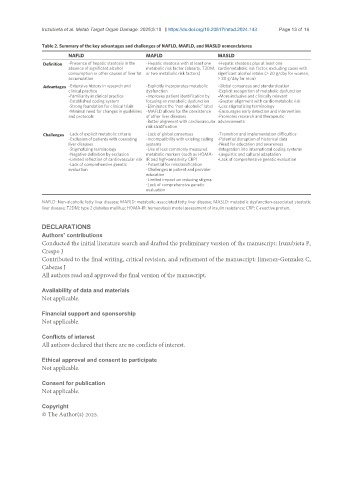
               Table 2. Summary of the key advantages and challenges of NAFLD, MAFLD, and MASLD nomenclatures
                        NAFLD                     MAFLD                   MASLD
                Definition  -Presence of hepatic steatosis in the   -Hepatic steatosis with at least one   -Hepatic steatosis plus at least one
                        absence of significant alcohol   metabolic risk factor (obesity, T2DM,  cardiometabolic risk factor, excluding cases with
                        consumption or other causes of liver fat  or two metabolic risk factors)  significant alcohol intake (> 20 g/day for women,
                        accumulation                                      > 30 g/day for men)
                Advantages -Extensive history in research and   -Explicitly incorporates metabolic   -Global consensus and standardization
                        clinical practice         dysfunction             -Explicit recognition of metabolic dysfunction
                        -Familiarity in clinical practice   -Improves patient identification by   -More inclusive and clinically relevant
                        -Established coding system   focusing on metabolic dysfunction   -Greater alignment with cardiometabolic risk
                        -Strong foundation for clinical trials   -Eliminates the “non-alcoholic” label  -Less stigmatizing terminology
                        -Minimal need for changes in guidelines  -MAFLD allows for the coexistence   -Encourages early detection and intervention
                        and protocols             of other liver diseases   -Promotes research and therapeutic
                                                  -Better alignment with cardiovascular  advancements
                                                  risk stratification
                Challenges  -Lack of explicit metabolic criteria   -Lack of global consensus   -Transition and implementation difficulties
                        -Exclusion of patients with coexisting   -Incompatibility with existing coding  -Potential disruption of historical data
                        liver diseases            systems                 -Need for education and awareness
                        -Stigmatizing terminology   -Use of less commonly measured   -Integration into international coding systems
                        -Negative definition by exclusion   metabolic markers (such as HOMA-  -Linguistic and cultural adaptation
                        -Limited reflection of cardiovascular risk  IR and high-sensitivity CRP)   -Lack of comprehensive genetic evaluation
                        -Lack of comprehensive genetic   -Potential for misclassification
                        evaluation                -Challenges in patient and provider
                                                  education
                                                  -Limited impact on reducing stigma
                                                  -Lack of comprehensive genetic
                                                  evaluation
               NAFLD: Non-alcoholic fatty liver disease; MAFLD: metabolic-associated fatty liver disease; MASLD: metabolic dysfunction-associated steatotic
               liver disease; T2DM: type 2 diabetes mellitus; HOMA-IR: homeostasis model assessment of insulin resistance; CRP: C-reactive protein.


               DECLARATIONS
               Authors’ contributions
               Conducted the initial literature search and drafted the preliminary version of the manuscript: Iruzubieta P,
               Crespo J
               Contributed to the final writing, critical revision, and refinement of the manuscript: Jimenez-Gonzalez C,
               Cabezas J
               All authors read and approved the final version of the manuscript.


               Availability of data and materials
               Not applicable.


               Financial support and sponsorship
               Not applicable.

               Conflicts of interest
               All authors declared that there are no conflicts of interest.

               Ethical approval and consent to participate
               Not applicable.

               Consent for publication
               Not applicable.

               Copyright
               © The Author(s) 2025.

